Best e-bike helmets: fit, ratings and design explained
A research-based shortlist, original diagrams and a fitting checklist for choosing beyond the badge.
Riding Nexus illustration
The short answer
The best e-bike helmets start with a secure fit and evidence for the exact model. Our research-based picks are the Specialized Mode for urban fit options and Tactic 4 for trail-style coverage. Both have five-star Virginia Tech ratings. Choose by head shape and riding needs; men's and women's labels don't establish fit.
Key takeaways
- Two shortlisted helmets have five-star Virginia Tech ratings; neither has been hands-on tested by Riding Nexus.
- NTA 8776 is a helmet standard, not a guarantee against injury at 28 mph (45 km/h).
- Check three separate things: certification label, independent rating and fit on your own head.
- AURA's product page and AHV1 manual leave a speed-use conflict; resolve it before buying for faster riding.
Jump to a section 10
- Which are the best e-bike helmets for different rides?
- Specialized Mode: our urban fit-options pick
- Specialized Tactic 4: our trail-style pick
- Why isn’t a smart helmet our automatic top pick?
- What do CPSC, NTA 8776, Mips and five stars actually mean?
- How should helmet shape influence your choice?
- What are the best e-bike helmets for women?
- What are the best e-bike helmets for men?
- How do you check fit before keeping a helmet?
- How much should you budget beyond the helmet price?
- Which buying mistakes should you avoid?
- Where does this advice come from?
You’re trying on a helmet with your commuting glasses, and the rear dial pushes it toward your eyebrows. That small conflict matters more than the color or the word “smart” on the box. This guide helps adult e-bike riders choose a helmet using US product specifications, independent lab evidence and a repeatable fitting check.
Which are the best e-bike helmets for different rides?
Start with the Specialized Mode for urban fit choices or the Tactic 4 for a trail-style design, provided the exact helmet fits you.
These are research-based recommendations, not Riding Nexus ride tests. We compared intended use, manufacturer specifications, independent ratings, purchasing limitations and fit options. We haven’t measured their cooling, noise, comfort or visibility in traffic, so there is no invented overall winner.
| Buying question | Mode | Tactic 4 |
|---|---|---|
| Why shortlist it? | Urban design with two headform choices | Trail design with a fixed visor |
| What needs checking? | Classic versus Round fit | Visor and eyewear clearance |
| US price checked November 2, 2026 | $49.99 final sale; listed regular price $119.99 | $119.99 |
| When would we skip it? | Untried fit with no return option | You need a different shape or chin coverage |
Prices are manufacturer page snapshots before tax or shipping, not a guarantee for every size, color or destination. Check the selected variant and return terms before payment. We aren’t assuming every displayed size is in stock.
Specialized Mode: our urban fit-options pick
The US Mode page, product 1000208081, lists Classic and wider Round headforms, hidden vents, Mips, NTA 8776 and CPSC compliance. The checked page showed Matte Black and S, M and L options. The $49.99 offer was explicitly final sale with no returns or exchanges.
Its headform choice earns its place here. Try both shapes when circumference alone hasn’t solved pressure points. It loses to a returnable alternative if you cannot establish fit before buying. The current page also says it no longer supports ANGi, so don’t buy on an older review’s connected-feature promise.
Specialized Tactic 4: our trail-style pick
Specialized currently titles US product 1000208435 “Tactic”; its product images identify Tactic 4, the name used in Virginia Tech’s listing. The checked Black, Classic-fit page lists S, M and L, Mips Evolve, NTA 8776 and CPSC compliance. Confirm that model match on the unit you receive.
The fixed visor, rear coverage and eyewear accommodation suit a rider seeking that layout. This is a design-based choice: we haven’t established that it runs cooler than Mode. It has no chin bar, and the current page says ANGi is no longer supported. Choose something else if the shell shape or visor interferes with your normal riding position.
For either pick, ask Specialized or its dealer to confirm replacement pads and fit-system parts for your exact version before you buy. We haven’t verified local stock of those parts. Spare comfort pads cannot repair damaged protective structure.
Why isn’t a smart helmet our automatic top pick?
Lights can be useful, but unresolved instructions and extra ownership tasks can outweigh them for a particular buyer.
We considered the UNIT 1 AURA Mips, whose US page lists integrated front and rear lights and NTA 8776. On November 2, 2026, its helmet-only offer displayed $220.92 against $259.90, with some sizes sold out. A remote is required for the advertised turn-signal and automatic brake-light functions; it isn’t part of the helmet-only comparison.
UNIT 1 is the brand, AURA is the model and Mips is an included helmet technology. AURA isn’t the name of a safety standard.
There is a consequential document mismatch. UNIT 1’s published English AHV1 manual, page 3, states a maximum e-bike use speed of 25 km/h (15.5 mph), while its current sales page promotes the NTA standard associated with speed-pedelec helmets. We cannot determine from those documents whether that sentence is outdated or applies to a particular version or market.
We therefore withhold a faster-riding recommendation. Ask UNIT 1 for current instructions matching the exact unit and your intended use before buying. This is an unresolved documentation issue, not a finding that the helmet failed a test.
The same manual says helmet lights supplement bike-mounted lights and turn indicators supplement hand signals. Budget time for charging and confirming operation. Also ask about servicing the integrated electronics; we haven’t verified a user-replaceable battery or long-term parts supply.
What do CPSC, NTA 8776, Mips and five stars actually mean?
They describe different evidence: regulatory compliance, a speed-pedelec standard, a technology and an independent test rating.
In the US, CPSC’s bicycle helmet requirements are in 16 CFR Part 1203. They cover impact attenuation, retention strength, positional stability and peripheral vision. Look for the compliance labeling on the actual helmet. A seller calling something an “e-bike helmet” doesn’t replace that evidence.
NEN explains that NTA 8776 helmets address higher drop speeds and more temple and rear-head coverage than the bicycle-helmet baseline it describes. The standard was developed for speed pedelecs, associated with assistance up to 45 km/h (about 28 mph). That context is not a guaranteed survivable crash speed. Road speed, the direction of an impact and what your head strikes are different quantities.
Mips describes a low-friction system intended to reduce rotational motion transmitted to the head in certain angled impacts. Rotational motion means turning; linear motion means movement along a line. Mips is a technology inside a complete helmet, not a substitute for its certification or comparative test results.
Virginia Tech uses 24 laboratory impacts across six locations in its bicycle STAR method. Lower STAR scores indicate better performance within that method, and more stars indicate lower modeled concussion risk in those scenarios. These are controlled comparisons, not a prediction of what will happen in your crash.
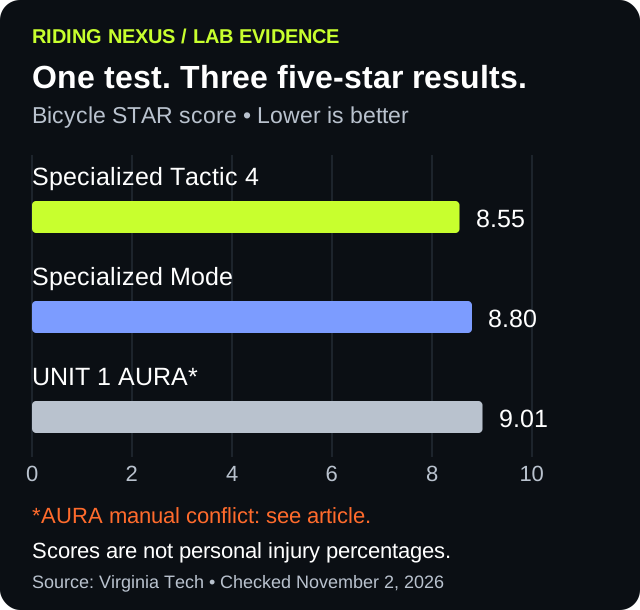
Don’t turn the difference between 8.55 and 8.80 into a personal percentage reduction in injury risk. Also avoid transferring a score to another generation, regional version or similarly named helmet without confirming the match.
How should helmet shape influence your choice?
Match the shell’s internal shape to your head, then check how coverage, vents and accessories work in your riding position.
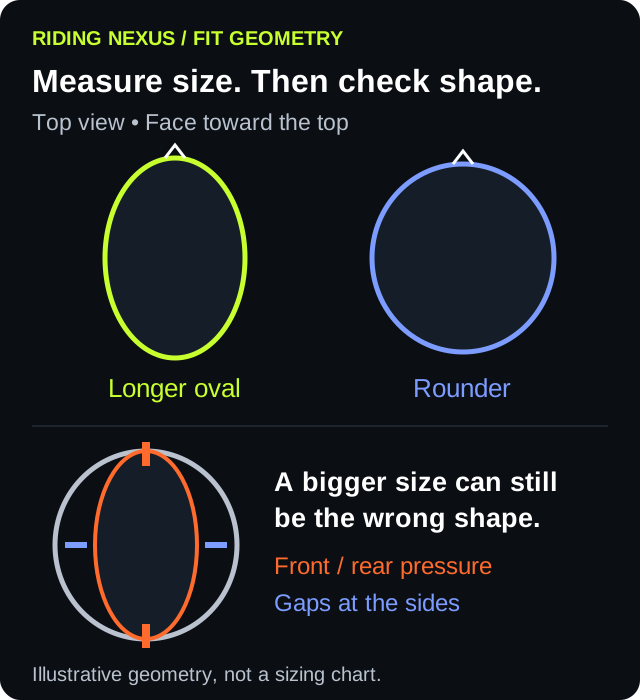
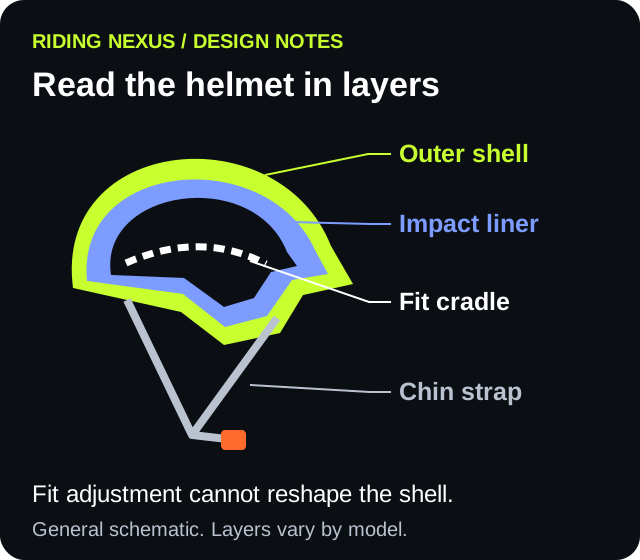
A circumference measurement gives you a starting size. It doesn’t describe every contour. Two people who measure the same distance around the head can need different internal shapes. A dial can adjust the fit system; it cannot turn the protective shell into a different shape.
The outer shell, impact-absorbing liner, comfort padding and retention system have different jobs. The soft pads that touch your head are not the entire protective liner. Don’t remove structural material to relieve a pressure point, drill a vent or alter a strap attachment. Use the adjustments and replacement parts the manufacturer permits.
For design choices, use a practical comparison:
| Design question | Urban shell | Trail-style shell |
|---|---|---|
| What should I inspect? | Air openings and rear adjustment access | Visor position and rear coverage |
| What should I try on with it? | Commuting glasses and usual hairstyle | Glasses or goggles actually worn |
| What can’t a photo establish? | Cooling or pressure on your head | Chin protection or impact performance |
Large-looking vents don’t prove better cooling. Channel layout, openings blocked by your head and riding conditions complicate that comparison. We have no matched airflow test for these picks, so we haven’t awarded a cooling score.
More visible shell coverage also doesn’t establish a percentage safety advantage. Treat coverage as a design feature to inspect alongside tested performance. An open-face helmet still leaves the chin uncovered. A plastic sun visor isn’t a protective chin bar.
What are the best e-bike helmets for women?
Use the same evidence-led shortlist, then prioritize the correct size, internal shape and clearance for your actual hairstyle and eyewear.
We found no basis in these product documents for a separate women’s safety ranking. A smaller helmet is useful only if its size range and shape fit you. Don’t infer head size from height, gender or the model in a product photo.
Bring your normal hair arrangement to the fitting. Check whether it pushes against the rear cradle, lifts the helmet or stops the dial from settling where its instructions require. If a ponytail conflicts with the fit system, try another arrangement or another helmet. We haven’t verified ponytail compatibility for every size of either pick.
Choose a shape you can wear correctly from the start. Planning to “get used to” a concentrated pressure point makes an online return deadline an expensive experiment. The Mode’s final-sale restriction makes an actual try-on especially useful.
What are the best e-bike helmets for men?
Start with measured head circumference and shape, then check the helmet with the glasses, facial hair and clothing you normally ride with.
A men’s label doesn’t establish that a shell is wider or larger. Use that model’s current size chart. If you sit near the upper limit, compare another size and another shape. Check the available adjustment on your head.
Check that the buckle closes correctly and the chin strap lies as instructed without catching hair. If glasses are pushed down or the helmet moves when you look over your shoulder, work through the fit adjustments before judging comfort. Those checks apply to anyone with the same fitting issue.
One shared shortlist makes comparisons clearer: women and men can choose different sizes or headforms without needing different standards of evidence. The best match may be the same model, or neither of our picks.
How do you check fit before keeping a helmet?
Measure first, follow the helmet’s instructions, then check position and stability with your normal riding accessories.
You need a soft tape measure, a mirror and the exact helmet’s manual. A helper makes strap positioning easier. This is a fitting task, not a repair; stop if the supplied adjustments cannot produce a stable fit.
-
Measure for the manufacturer's size chart
Measure around your head at the position its instructions specify. Try the suggested size and compare shapes if pressure is uneven.
-
Set the helmet level
NHTSA advises a low, level position, one or two finger-widths above the eyebrows. Adjust the fit system according to the model's manual.
-
Set the straps
NHTSA describes a V below and slightly in front of each ear, with the chin buckle centered and a snug strap allowing no more than one or two fingers beneath it.
-
Check movement
With the buckle fastened, check for rocking toward your eyes, away from your forehead or sideways. Refit if it shifts; seek fitting help if adjustment doesn't solve it.
-
Repeat with your riding accessories
Put on your glasses and use your usual hairstyle. Look forward and over each shoulder. Check again whenever those choices change.
Follow model-specific instructions where the strap or fit mechanism differs. A secure fit should not depend on an unapproved thick pad, an altered buckle or a hat that changes the helmet’s position.
How much should you budget beyond the helmet price?
Budget for the fitted helmet, necessary accessories and eventual replacement; avoid treating a sale price as the full decision.
Before ordering, write down the helmet-only price, delivery and return costs, any optional visor or remote, and what happens if the electronics stop working. Check whether the seller is authorized and whether its warranty applies in your market. We haven’t verified every seller’s terms or local service capacity.
A hypothetical $120 helmet kept for three years would allocate $40 a year before accessories. That is a budgeting example, not a recommended replacement interval. An impact or damage can require replacement much earlier; follow your helmet manufacturer’s lifespan and inspection instructions even if a cost calculation assumes longer use.
If you’re assessing a whole commuting budget, use our E-Bike vs Car Calculator and add equipment costs separately where they aren’t included. Our e-bike range guide helps assess the route and battery side of that decision. Neither tool determines the correct helmet.
Which buying mistakes should you avoid?
Avoid confusing a marketing label with certification, a lab score with fit, or a low price with a usable purchase.
- Buying the wrong size because the desired color is discounted.
- Assuming every helmet with the same family name has the tested construction.
- Reading “NTA 8776” as guaranteed protection in any 28 mph crash.
- Expecting a built-in light or app to replace the bike equipment and signaling your route requires.
- Buying used protective equipment whose impact history you cannot establish.
- Adding unapproved mounts, drilling the shell or trimming the liner to make an accessory fit.
Check the exact identifiers against the CPSC recall database and the manufacturer’s safety notices before purchase. Our November 2 review found no notice naming Mode or Tactic 4 in the material checked; that limited search isn’t proof of safety or a promise about future recalls.
For UK, EU, Swiss and other purchases, verify local requirements and the actual regional label. This US-market shortlist doesn’t establish legal compliance in every country. If your vehicle falls outside bicycle use, get advice for that vehicle category before applying this list.
Where does this advice come from?
It combines primary product documents, NEN and CPSC guidance, NHTSA fitting instructions and Virginia Tech’s published laboratory results.
Specifications and prices were checked on November 2, 2026. These are current product-page references, not a claim that every helmet is a newly released 2026 model. Exact source titles appear below; the editorial evidence ledger retains the URLs and version limits. This article contains no retailer or affiliate sales links.
Our original contribution is the separation of fit, certification, test performance and ownership choices, including the unresolved AURA document conflict. We haven’t worn, crash-tested or measured these helmets. We didn’t assign proprietary safety scores or infer a comfort winner from customer reviews.
The shortlist is deliberately small. Mode earns its place for the available headforms, and Tactic 4 for its trail-style layout. AURA’s electronics don’t resolve its documentation question. Other helmets can be a better personal fit; omission from this guide is not a negative test result.
Frequently asked questions
Are more expensive e-bike helmets always safer?
Price alone doesn't establish protection. Compare the certification and independent results for the exact helmet, then check its fit. Extra cost can buy lights, a visor or finish choices. Those additions have separate uses, but they don't prove a better result in an impact test or on your head.
Can women and men use the same e-bike helmet?
Women and men can start with the same helmet shortlist. Choose the correct circumference range and internal shape, then check the straps and rear adjustment with your usual hairstyle and eyewear. A women's or men's category label doesn't tell you whether that particular shell will sit level and stay secure.
Does an e-bike helmet need Mips?
Mips is one approach to managing rotational motion in certain angled impacts. It isn't a helmet certification, and its presence alone doesn't establish how a complete helmet compares with another. Use the exact model's independent results alongside the applicable certification and a proper fit. One logo cannot answer all those questions.
Can I use these helmets for an electric motorcycle?
This shortlist covers adult bicycle use. It doesn't establish suitability for an electric motorcycle, moped or every form of downhill riding. Check the vehicle category, local requirements and helmet manufacturer's intended use. A bicycle helmet's e-bike marketing label doesn't demonstrate compliance with a motorcycle helmet standard.
Sources & references
We cite primary sources wherever possible: standards bodies, regulators, manufacturers and peer-reviewed research. See our editorial policy.
- Bicycle helmets business guidance: 16 CFR Part 1203
- Speed-pedelec helmet certification and NTA 8776 register
- Bicycle helmet ratings and STAR methodology
- Fitting your bike helmet, DOT HS 811 568
- Mode: US product specification, product 1000208081
- Tactic: US product specification, product 1000208435
- Bicycle helmet owner's manual, English, 0000169175 OM R6, June 2026
- AURA Mips: US product specification and sizing
- AURA AHV1 safety instructions, English, pages 1 to 3
- Helmet technology and low-friction layer
- Recalls and product safety warnings
- Safety recall notices