High-speed electric bikes: Class 3 vs speed pedelec
Both assist to the same speed. One is a bicycle with extra rules, the other is a moped with pedals. Here's which one fits your ride.
The short answer
High-speed electric bikes assist up to 28 mph (45 km/h). In the US that is a Class 3 e-bike: a bicycle with a speedometer, and in California an age minimum of 16 and a helmet. In the EU it is a speed pedelec: a type-approved L1e-B moped that needs an AM licence and national moped paperwork.
Key takeaways
- US Class 3 and EU speed pedelecs both assist to 28 mph (45 km/h), but only Class 3 is legally a bicycle.
- A speed pedelec is an L1e-B moped under EU Regulation 168/2013 and needs an AM licence, minimum age 16 by default.
- The Stromer ST7 is sold as both: 940 W and 45 km/h in the EU, 750 W and 28 mph as a US Class 3.
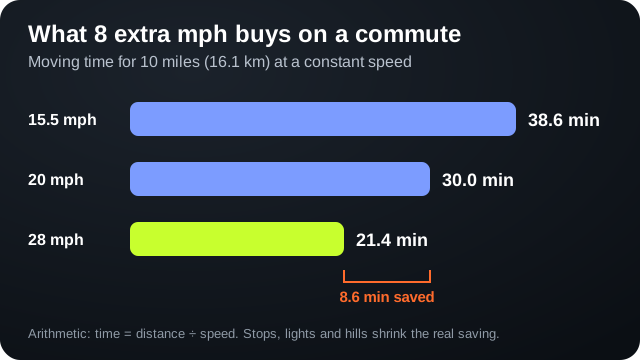
- At a steady 28 mph instead of 20 mph, a 10-mile commute takes 21.4 minutes instead of 30.0.
- Our model shows 28 mph uses about 75% more energy per mile than 20 mph, so plan a bigger battery.
Jump to a section 7
- What counts as a high-speed electric bike?
- How is a Class 3 e-bike different from a speed pedelec?
- What do speed pedelec rules look like in the Netherlands and Switzerland?
- Is a 28 mph e-bike worth it for commuting?
- What should you check before buying a high-speed e-bike?
- Mistakes to avoid with a 28 mph e-bike
- Where this information comes from
High-speed electric bikes are the 28 mph (45 km/h) tier: the fastest bikes that still have pedals and a legal path onto public roads. The US and EU reach that speed through two different legal doors. This guide compares a US Class 3 e-bike with an EU speed pedelec, so you can tell which one you can ride, what it asks of you and whether the speed is worth it on your commute.
What counts as a high-speed electric bike?
A high-speed electric bike is one whose motor assists above the standard 20 mph or 25 km/h limit, up to 28 mph (45 km/h).
| Question | US Class 3 e-bike | EU speed pedelec |
|---|---|---|
| Assist stops at | 28 mph (45 km/h) | 45 km/h (28 mph) |
| Legally a | Bicycle, under state law | L1e-B moped |
| Motor limit | 750 W (California) | Up to 4,000 W (L1e) |
| Licence | None in California | Category AM |
| Minimum age | 16 in California | 16 by default, 14 to 18 by country |
| Plate and insurance | Not required in California | Set by national moped rules |
The Class 3 column follows California Vehicle Code 312.5 and 21213. Other states adopt similar classes with their own age, helmet and path rules.
How is a Class 3 e-bike different from a speed pedelec?
A Class 3 e-bike is a bicycle with extra rules, while a speed pedelec is a type-approved moped that happens to have pedals.
Under EU Regulation 168/2013, the bicycle exemption ends at 250 W and 25 km/h. Above that, an e-bike sits in category L1e, capped at 45 km/h and 4,000 W. If it can’t meet the L1e-A “powered cycle” limits of 25 km/h and 1,000 W, it’s an L1e-B two-wheel moped. EU licence law (Directive 2006/126/EC) puts mopeds up to 45 km/h in category AM, excluding vehicles capped at 25 km/h, with a minimum age of 16 that each country can move between 14 and 18.
The Stromer ST7 shows both doors on one frame. Stromer lists the EU model as “L1e-B, up to 45 km/h” with 940 W, and the US model as “USA Class 3, up to 28 mph” with 750 W. The battery (1,440 Wh) and torque (52 Nm) are the same. The legal paperwork is not.
What do speed pedelec rules look like in the Netherlands and Switzerland?
Speed pedelec rules in the Netherlands and Switzerland both require a plate and a licence, but they differ on age, helmets and paths.
| Question | Netherlands | Switzerland (fast e-bike) |
|---|---|---|
| Minimum age and licence | 16, moped licence AM | 14, category M licence |
| Plate | Yellow moped plate | Registration and plate |
| Insurance | Third-party liability (WA) | Not covered in ASTRA’s summary |
| Helmet | Approved moped helmet or NTA 8776:2016 | Bicycle helmet, mandatory |
| Paths | Not on bicycle-only paths | Rides as a cyclist; moped bans apply |
| Extra kit | Left rear-view mirror | Speedometer, up to 1,000 W |
The Dutch column comes from Rijksoverheid, which also caps speed pedelecs at 40 km/h on combined bicycle and moped paths outside built-up areas and 30 km/h inside them. The Swiss column comes from the Federal Roads Office (ASTRA) summary dated July 1, 2025. Its fast e-bike assists to 45 km/h with pedaling and 30 km/h on motor power alone.
In the UK neither version is a bicycle. GOV.UK treats any e-bike that assists above 15.5 mph as a motorcycle or moped, with approval, registration, tax, insurance, a licence and a motorcycle helmet.
Is a 28 mph e-bike worth it for commuting?
A 28 mph e-bike is worth it when your commute is long and mostly open road, because time saved grows with distance while the energy cost grows faster than the speed.
Speed costs battery. In our speed versus range model, holding 28 mph takes about 24.6 Wh per mile at the wheel, against 14.1 Wh at 20 mph. That’s about 75% more energy for each mile. A battery that covers your round trip at 20 mph may not cover it at 28.
Here’s the rule we’d use. If your one-way commute is under 5 miles (8 km) with frequent junctions, a 20 mph bike gets you there within a few minutes of a 28 mph one. Over 10 miles (16 km) on open roads, the faster class starts to pay for its extra rules and battery. The e-bike vs car cost calculator helps you check whether the faster bike can replace driving.
What should you check before buying a high-speed e-bike?
Check the legal class on the label, the brakes, the tires and the battery size before you pay for a high-speed e-bike.
-
Confirm the class or approval
A US Class 3 bike carries a class label and a speedometer. An EU speed pedelec comes with type-approval paperwork for registration.
-
Check the motor rating
Ask for the continuous rated power and the cut-off speed for your market version. Peak watts don't tell you the legal class.
-
Size the battery for 28 mph
Plan on roughly 75% more energy per mile than at 20 mph, then check your round trip in the range calculator.
-
Look at brakes and tires
Ask the seller what speed and total weight the brakes and tires are rated for.
-
Check where you can ride
Look up your state's or country's path rules. Some keep 28 mph bikes off shared paths.
The continuous vs peak motor power entry explains why a peak figure on a listing doesn’t settle the class.
Mistakes to avoid with a 28 mph e-bike
- Importing a US Class 3 bike into the UK or EU and riding it as a bicycle. It isn’t one there.
- Wearing your normal bicycle helmet on a speed pedelec without checking local rules. Some countries ask for more; see our e-bike helmet guide.
- Sizing the battery from the 20 mph range claim. The maker’s range figure usually assumes lower speeds and assist levels.
Where this information comes from
Legal rules come from California Vehicle Code 312.5 and 21213, EU Regulation 168/2013, Directive 2006/126/EC, GOV.UK, Rijksoverheid and ASTRA, checked November 3, 2026. Stromer specifications come from Stromer’s ST7 page on the same date. The commute times and energy figures are our arithmetic and physics model; we haven’t ridden these bikes for this guide.
Frequently asked questions
Is a speed pedelec the same as a Class 3 e-bike?
A speed pedelec and a Class 3 e-bike both assist up to 45 km/h (28 mph), but they are not the same in law. A Class 3 e-bike is a bicycle under US state law. A speed pedelec is a type-approved L1e-B moped in the EU, with an AM licence and national moped rules.
Do you need a licence for a high-speed e-bike?
A high-speed e-bike needs a licence in the EU, where a 45 km/h speed pedelec falls in driving licence category AM. In California, a Class 3 e-bike needs no licence, but riders must be 16 or older and wear a helmet. In the UK, any e-bike assisting above 15.5 mph needs a licence.
Can I ride a Class 3 e-bike in the UK?
A US Class 3 e-bike can't be ridden in the UK as a bicycle, because its motor assists above 15.5 mph. GOV.UK says an e-bike outside the EAPC rules is classed as a motorcycle or moped, needing approval, registration, tax, insurance, a licence and a motorcycle helmet.
How much time does a 28 mph e-bike save?
A 28 mph e-bike saves about 8.6 minutes of moving time over 10 miles compared with 20 mph, if you could hold each speed the whole way. Real commutes include stops and slower stretches, so the saving is smaller. Longer, open-road commutes gain the most.
Sources & references
We cite primary sources wherever possible: standards bodies, regulators, manufacturers and peer-reviewed research. See our editorial policy.
- California Vehicle Code section 312.5: electric bicycle classes
- California Vehicle Code section 21213: Class 3 age and helmet rules
- Regulation (EU) No 168/2013, Article 2 and Annex I
- Directive 2006/126/EC on driving licences, Article 4 (category AM)
- Electric bikes: licensing, tax and insurance
- Speedpedelec: regels
- Rules for slow e-bikes, fast e-bikes and mopeds, as of July 1, 2025
- Stromer ST7 specifications