How fast do electric bikes go? Speeds by class and country
Your e-bike's speed is set by its legal class, then by your legs, the hills and the wind. Here's how each part works.
The short answer
Electric bikes go as fast as their legal class lets the motor help: 15.5 mph (25 km/h) for UK EAPCs and EU pedelecs, 20 mph (32 km/h) for US Class 1 and 2, and 28 mph (45 km/h) for US Class 3 and EU speed pedelecs. Past that point the motor stops, but you can still pedal or coast faster.
Key takeaways
- UK and EU e-bikes stop assisting at 15.5 mph (25 km/h); the GOV.UK EAPC rules set 250 W continuous power.
- US Class 1 and Class 2 stop at 20 mph (32 km/h); Class 3 assists to 28 mph (45 km/h) and must have a speedometer.
- On throttle alone, a US Class 2 bike reaches 20 mph; California allows walk assist to 3.7 mph on Class 1 and 3.
- Above the cut-off, the motor adds nothing, but the bike still goes faster downhill or with harder pedaling.
- The power to hold speed rises with the cube of speed: about 282 W at 20 mph and 689 W at 28 mph in our model.
Jump to a section 7
You’re halfway up a long, straight road, the motor hums, and the speedometer settles at 20 mph and won’t climb any further. That number is no accident. This guide explains how fast electric bikes go in the US, UK and EU, what the motor does at each limit, and what still moves the needle once it stops.
How fast do electric bikes go?
Electric bikes go as fast as their legal class allows the motor to help: 15.5 mph (25 km/h) in the UK and EU, 20 or 28 mph in the US.
| Where and which class | Motor helps up to | Throttle allowed |
|---|---|---|
| UK EAPC | 15.5 mph (25 km/h) | Only on an approved bike |
| EU pedelec | 25 km/h (15.5 mph) | No, assist needs pedaling |
| US Class 1 | 20 mph (32 km/h) | No |
| US Class 2 | 20 mph (32 km/h) | Yes, to 20 mph |
| US Class 3 | 28 mph (45 km/h) | Varies by state |
| EU speed pedelec | 45 km/h (28 mph) | Moped rules apply |
In Great Britain, GOV.UK says an EAPC’s motor “must not be able to propel the bike when it’s travelling at more than 15.5 miles per hour” and must have a continuous rated power of 250 W or less. In the EU, Regulation 168/2013 requires the assist to be “finally cut off before the vehicle speed reaches 25 km/h” for a pedelec to stay outside moped law.
In the US, the federal product rule in 15 U.S.C. 2085 covers bikes under 750 W that do less than 20 mph on motor power alone. The three-class system comes from state law. California Vehicle Code 312.5 is a common model: Class 1 and Class 2 stop at 20 mph, and Class 3 stops at 28 mph and needs a speedometer.
How fast can an electric bike go without pedaling?
An electric bike can go 20 mph without pedaling only if it’s a US Class 2 throttle bike; most other legal e-bikes need you to pedal for any real speed.
California lets Class 1 and Class 3 bikes have walk or start assist that moves the bike on motor power alone up to 3.7 mph. In Great Britain, GOV.UK says an e-bike “can be propelled up to 15.5mph without pedalling but only if it’s been approved”; an unapproved twist-and-go is a moped. In the EU, the pedelec exclusion in Regulation 168/2013 requires the motor to cut off when you stop pedaling, so a throttle that drives the bike on its own takes it into vehicle approval.
If you want a throttle, check the class sticker before you buy. A US Class 2 label means throttle to 20 mph. A bike sold with a throttle in the UK without approval paperwork is the one to avoid.
Can you ride an e-bike faster than its speed limit?
You can ride faster than the assist limit on your own power or downhill, because the law limits the motor, not the bike.
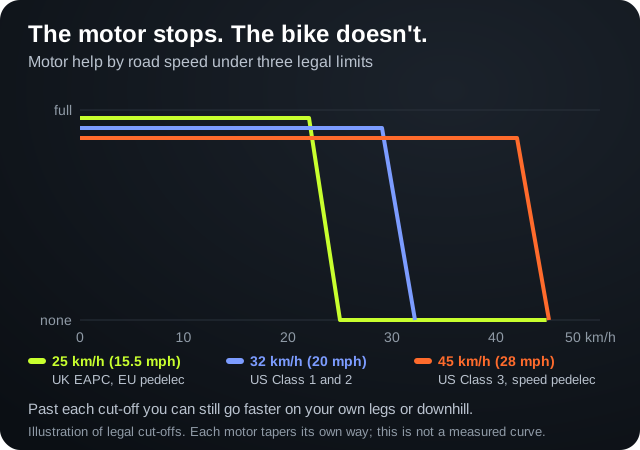
Above the cut-off, a heavy e-bike becomes hard work. Air drag grows with the square of speed, so the power to beat it grows with the cube. Wikipedia’s bicycle performance page shows a 90 kg road rider and bike needing about 175 W at 32 km/h and about 300 W at 40 km/h on the flat. On an upright e-bike, with more frontal area and more weight, our model puts 20 mph at about 282 W.
So most riders on a 15.5 mph pedelec cruise a little above the limit on flat ground, if at all, and drop back to the cut-off as soon as the road tilts up. Our speed versus range guide shows the full curve.
Why doesn’t my e-bike reach its top speed?
An e-bike that doesn’t reach its cut-off is usually limited by assist mode, gradient, wind, tire pressure or load, not by a fault.
The cut-off is a ceiling. In a low assist mode the motor adds a smaller share of your effort, so you run out of legs before the motor runs out of permission. A climb or a headwind adds demand that neither of you can cover at full speed. Soft tires raise rolling resistance; the tire pressure guide gives a starting point for your tire width and weight.
If a bike that used to reach its cut-off no longer does on the same flat road and mode, look for a dragging brake, a dry chain or a speed sensor magnet that has moved. Our guide to making an e-bike faster legally walks through each check in order.
What’s the fastest an e-bike can go?
The fastest e-bikes on motor power assist to 28 mph (45 km/h); anything faster is a moped, motorcycle or off-road vehicle.
Off-road electric dirt bikes such as the Sur-Ron Light Bee X list 50 mph, but they have no pedals and aren’t e-bikes in law. Our fastest e-bikes guide ranks every step of the speed ladder with the models on it, and our high-speed e-bike guide compares 28 mph Class 3 bikes with 45 km/h speed pedelecs.
Mistakes riders make about e-bike speed
- Reading “750 W” or “1,000 W peak” as a speed. Watts tell you about climbing and acceleration; the class tells you the speed.
- Planning a commute at the cut-off speed. Junctions, lights and hills mean your average is lower. Use the speed and distance calculator with a realistic average, not the top speed.
- Assuming a 28 mph bike is legal everywhere. A Class 3 bike in California is barred to riders under 16, and other states and trail managers set their own rules. Check the e-bike laws guide for your area.
Where this information comes from
Legal speeds come from GOV.UK, EU Regulation 168/2013, 15 U.S.C. 2085 and California Vehicle Code 312.5, all checked November 3, 2026. Power figures come from the standard cycling power formula, with the assumptions shown in our speed versus range guide. We haven’t measured individual bikes for this page.
Frequently asked questions
How fast does an electric bike go in km/h?
An electric bike in the UK and EU assists up to 25 km/h. A US Class 1 or Class 2 e-bike assists up to about 32 km/h (20 mph), and a Class 3 up to about 45 km/h (28 mph). An EU speed pedelec, which is a type-approved moped, also assists up to 45 km/h.
How fast can an electric bike go without pedaling?
An electric bike without pedaling can reach 20 mph on throttle if it is a US Class 2. Class 1 and Class 3 bikes need pedaling, apart from walk assist, which California caps at 3.7 mph. In Great Britain, a throttle above walking pace is allowed only on a type-approved bike, up to 15.5 mph.
Can an e-bike go faster than 28 mph?
An e-bike can go faster than 28 mph downhill or under strong pedaling, but a Class 3 motor stops helping at 28 mph. Bikes whose motor pushes past that are no longer e-bikes in law. They are mopeds, motorcycles or off-road vehicles, with different rules for roads and trails.
Why does my e-bike feel slower than its top speed?
An e-bike feels slower than its top speed because the cut-off is a ceiling, not a cruising speed. A low assist mode, a headwind, a climb, soft tires or extra load all mean the motor and your legs can't reach it. Above the cut-off, every mile per hour comes from your legs alone.
Sources & references
We cite primary sources wherever possible: standards bodies, regulators, manufacturers and peer-reviewed research. See our editorial policy.