Fastest e-bikes: how fast the quickest models really go
The fastest e-bike depends on which rulebook it rides under. Here is the speed ladder, the bikes at each step and what the extra speed costs you.
The short answer
The fastest e-bikes you can ride legally as a bicycle in the US are Class 3 models, which assist up to 28 mph (45 km/h). In the EU, speed pedelecs also reach 45 km/h but count as mopeds. Faster electric dirt bikes exist: the Sur-Ron Light Bee X lists 50 mph and the Segway X260 46.6 mph, both for off-road use only.
Key takeaways
- US Class 3 is the fastest bicycle-class e-bike: assistance stops at 28 mph (45 km/h) under California Vehicle Code 312.5.
- UK and EU pedelecs stop assisting at 15.5 mph (25 km/h); a 45 km/h EU speed pedelec is a type-approved moped.
- The Stromer ST7 is one bike in two legal forms: 45 km/h with 940 W in the EU, 28 mph with 750 W as a US Class 3.
- In our physics model, holding 28 mph takes about 689 W versus 282 W at 20 mph: 2.4 times the power for 40% more speed.
- Off-road machines such as the Sur-Ron Light Bee X (50 mph listed) have no pedals and are not legal e-bikes on public roads.
The fastest e-bike you can ride as a bicycle tops out at 28 mph (45 km/h) of motor help, and that ceiling comes from the law, not the motor. This guide is for riders shopping for speed in the US, UK or EU. It shows the six steps of the speed ladder, the real bikes on each step, and why every extra mile per hour costs more than the last.
What is the fastest e-bike on the market?
The fastest e-bike on the market is whichever bike sits on the top step of the rules you ride under: 28 mph in the US, 45 km/h as an EU moped, or about 50 mph off-road.
Brand blogs that rank the “fastest e-bikes” often mix three kinds of machine on one list. That is why one page says 28 mph and the next says 70 mph. We sorted the claims by legal category and kept only figures a maker publishes on its own spec page.
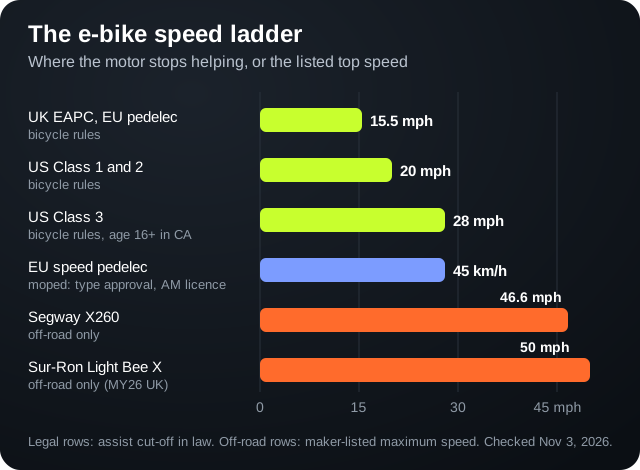
| Speed step | Top motor speed | What the law calls it |
|---|---|---|
| UK EAPC, EU pedelec | 15.5 mph (25 km/h) | Bicycle |
| US Class 1 and 2 | 20 mph (32 km/h) | Bicycle in most states |
| US Class 3 | 28 mph (45 km/h) | Bicycle, with extra rules |
| EU speed pedelec | 45 km/h (28 mph) | L1e-B moped |
| Electric dirt bike | 46.6 to 50 mph (75 to 80 km/h) listed | Off-road vehicle |
The US federal product definition in 15 U.S.C. 2085 covers bikes with a motor under 750 W that reach less than 20 mph on motor power alone, tested with a 170 lb rider on level pavement. State class laws then decide where faster pedal assistance can go.
What is the fastest legal e-bike?
The fastest legal e-bike in the US is a Class 3 model, which assists up to 28 mph (45 km/h); in the UK, every legal e-bike stops at 15.5 mph (25 km/h).
California Vehicle Code 312.5 defines a Class 3 e-bike as one whose motor “ceases to provide assistance when the bicycle reaches the speed of 28 miles per hour” and which is equipped with a speedometer. Section 21213 bars riders under 16 and requires a bicycle helmet. Other states write their own versions, so age, helmet and path rules for Class 3 vary.
In the EU, Regulation 168/2013 leaves pedelecs out of vehicle type approval only when the motor is 250 W or less and cuts off before 25 km/h. A bike that assists to 45 km/h falls into the L1e moped category, which allows up to 4,000 W and needs type approval. EU licence law (Directive 2006/126/EC) puts it in category AM, with a minimum age of 16 that each country may move between 14 and 18. National moped rules then set plates, insurance and where you may ride. Our high-speed e-bike guide compares a 28 mph Class 3 bike with a 45 km/h speed pedelec in detail.
The Stromer ST7 shows the split in one product. Stromer’s spec page lists the EU version as “L1e-B, up to 45 km/h” with a 940 W motor, and the US version as “USA Class 3, up to 28 mph” with 750 W. Both use the same 1,440 Wh battery and 52 Nm of torque. Same bike, two rulebooks, two top speeds.
Who makes the fastest e-bike?
No single brand makes the fastest road-legal e-bike, because the law sets the same ceiling for every maker; the bikes that go faster are off-road electric dirt bikes.
Here are the fastest models we could verify on the maker’s own pages, as of November 3, 2026:
| Model | Listed speed | Road status |
|---|---|---|
| Stromer ST7 (EU) | 45 km/h assisted | L1e-B moped, plate needed |
| Stromer ST7 (US) | 28 mph assisted | Class 3 e-bike |
| Segway X260 | 46.6 mph (75 km/h) maximum | No road status stated |
| Sur-Ron Light Bee X MY26 (UK) | 50 mph top speed | “Off-road use only” |
Sur-Ron UK lists the Light Bee X MY26 at 50 mph with 10 kW maximum power and a 72 V, 35 Ah (2.5 kWh) battery, and states “Road Legal No”. Segway’s support page lists the X260 at 46.6 mph (75 km/h) with 5 kW maximum power. Both have footpegs instead of pedals, so neither is an e-bike in law. Our Segway X260 vs Sur-Ron Light Bee X guide covers those two in depth.
The best-known pedal-equipped bike in this speed range is the Delfast Top 3.0. RideApart reported it at launch in June 2020 with a 50 mph top speed and a 72 V, 48 Ah battery, under the subtitle “Pedals for ornamental purposes only.” Delfast’s own website no longer loads (checked November 3, 2026), so we can’t confirm current specs or availability, and it isn’t in our table. Retailer blogs name other pedal bikes at up to 70 mph; we found no maker spec page that confirms them. At those speeds the pedals don’t make it a bicycle in law.
Why can’t a legal e-bike just go faster?
A legal e-bike can’t go faster on motor power because its motor must stop at the cut-off, and the physics makes each extra mph more expensive anyway.
Air resistance grows with the square of speed, so the power to push through it grows with the cube. Wikipedia’s bicycle performance page gives a worked example: a 90 kg road rider and bike need about 175 W at 32 km/h, with 76% of that going into air drag, and about 300 W at 40 km/h, with 83%.
We ran the same formula for a more upright e-bike rider. With a 120 kg rider and bike, a drag area of 0.5 m², a rolling coefficient of 0.006 and still air, holding speed on the flat takes:
- At 15.5 mph
- 152 W 25 km/h
- At 20 mph
- 282 W 32 km/h
- At 28 mph
- 689 W 45 km/h
- At 35 mph
- 1,284 W 56 km/h
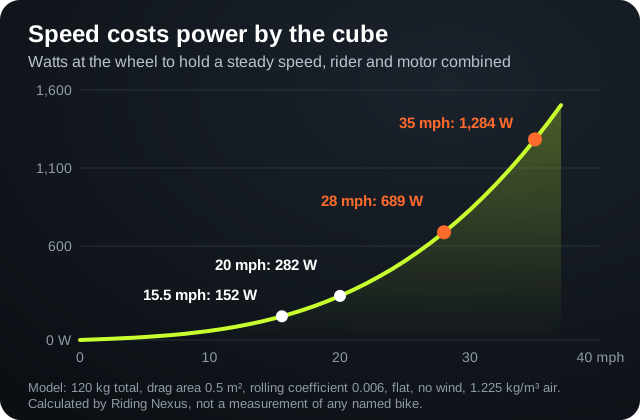
The drag area of 0.5 m² is our assumption for an upright rider, not a measured value; a crouched rider has less. Compare the 689 W at 28 mph with the 175 W the Wikipedia road rider needs for 32 km/h: on a Class 3 bike at full assist, the motor carries most of the load. The speed versus range guide shows what that does to your battery.
How do you choose a fast e-bike to buy?
Choose a fast e-bike by deciding which legal class you’ll ride, then checking the battery, brakes and paperwork that class demands.
- If you ride in the US and want the most speed without a license, buy a Class 3 e-bike with a speedometer and check your state’s age and path rules.
- If you commute in the EU over 15 km (9 miles) each way on roads, a speed pedelec makes sense only if you accept an AM licence and your country’s moped rules for plates, insurance and helmets.
- If you ride in Switzerland, a fast e-bike assists to 45 km/h with up to 1,000 W. The Swiss Federal Roads Office (ASTRA) requires a plate, a category M licence (available from 14), a speedometer and a bicycle helmet.
- If you’re in the UK, any e-bike faster than 15.5 mph of assist needs registration as a moped or motorcycle. Most riders stay with an EAPC.
- If your rides are off-road on private land, an electric dirt bike gives you 45 mph and more, but not on public roads or trails.
For a 28 mph bike, size the battery for the speed. In our model the motor-only energy at 28 mph is about 24.6 Wh per mile, against 14.1 Wh at 20 mph. Our e-bike range calculator lets you put your own speed, weight and battery into the same kind of estimate.
Mistakes to avoid when buying for speed
The most common mistake is buying a peak-watt number as if it were a speed number. A listing that says “1,500 W peak” tells you about short bursts, not the legal class. Ask for the continuous rated power, the assist cut-off speed and the market version.
Other mistakes we see in buyer questions:
- Buying a bike with an “off-road mode” and riding it on the street in that mode. On public roads it may no longer count as an e-bike.
- Fitting a tuning kit to a 15.5 mph bike. Our guide to making an e-bike faster explains the legal routes and the legal risk.
- Riding a 45 km/h speed pedelec in a helmet chosen for 15.5 mph without checking local rules. NTA 8776 is a helmet standard developed for speed-pedelec riders; see our e-bike helmet guide.
- Assuming the speed you see on a test ride is the speed you’ll average. Lights, junctions and hills bring real averages well below the cut-off. Our guide on how fast electric bikes go separates top speed from average speed.
Where these numbers come from
Legal limits come from the statutes and government pages linked in each section, checked November 3, 2026. Model speeds come from the makers’ spec pages on the same date; we haven’t ridden or timed these bikes. The power and range figures are our own calculation from the standard cycling power formula, with every assumption stated beside the chart. Change the assumptions and the numbers move, but the shape of the curve doesn’t. Swiss rules come from ASTRA’s July 1, 2025 summary; the full country comparison is in our e-bike laws guide.
Frequently asked questions
What is the fastest e-bike on the market?
The fastest e-bike on the market depends on the rules it is sold under. As a road-legal bicycle in the US, the ceiling is Class 3 assistance to 28 mph. As an EU moped, a speed pedelec reaches 45 km/h. Off-road electric dirt bikes go further: Sur-Ron lists 50 mph for the Light Bee X MY26.
What is the fastest legal e-bike in the US?
The fastest legal e-bike in the US is a Class 3 e-bike, which gives pedal assistance up to 28 mph (45 km/h) and must have a speedometer under California Vehicle Code 312.5. California bars riders under 16 from Class 3 bikes and requires a helmet. Other states write their own rules, so check yours before buying.
Can an e-bike go 40 mph?
A road-legal e-bike cannot use its motor at 40 mph. The motor stops assisting at 20 or 28 mph in the US and 25 or 45 km/h in Europe. You can exceed that downhill or under your own power. Bikes whose motor pushes them to 40 mph or more are electric motorcycles or off-road machines.
Who makes the fastest e-bike?
No single maker makes the fastest e-bike, because the law caps every road-legal one. Many brands sell 28 mph Class 3 models; Stromer sells the ST7 at 45 km/h in the EU. Among off-road electric dirt bikes, Sur-Ron lists 50 mph for the Light Bee X MY26 and Segway lists 46.6 mph for the X260.
Is a faster e-bike worth it for commuting?
A faster e-bike is worth it when your commute is long and mostly open road. At a steady 28 mph instead of 20 mph, a 10-mile ride takes 21.4 minutes instead of 30. Our physics model shows that speed costs about 75% more energy per mile, so budget a bigger battery.
Sources & references
We cite primary sources wherever possible: standards bodies, regulators, manufacturers and peer-reviewed research. See our editorial policy.
- California Vehicle Code section 312.5: electric bicycle classes
- California Vehicle Code section 21213: Class 3 age and helmet rules
- 15 U.S. Code § 2085: Low-speed electric bicycles
- Electric bikes: licensing, tax and insurance
- Regulation (EU) No 168/2013, Article 2 and Annex I
- Directive 2006/126/EC on driving licences, Article 4 (category AM)
- Stromer ST7 specifications
- Sur-Ron Light Bee X MY26 specifications
- Segway X260 product support and specifications
- Rules for slow e-bikes, fast e-bikes and mopeds, as of July 1, 2025
- Delfast Top 3.0 electric bike launched
- Bicycle performance: power and aerodynamic drag