E-bike speed vs range: how much faster riding costs
Air drag grows with the square of speed, so every extra mile per hour costs more battery than the last. Here are the numbers.
The short answer
Riding an e-bike faster cuts range because the power to beat air drag rises with the cube of speed. In our physics model for an upright 120 kg rider and bike, energy use climbs from about 14.1 Wh per mile at 20 mph to 24.6 Wh per mile at 28 mph, about 75% more. The same 450 Wh then covers roughly 43% fewer miles.
Key takeaways
- Aerodynamic drag power rises with the cube of speed; at 28 mph it is about 87% of the total in our model.
- Model energy at the wheel: 9.8 Wh/mile at 15.5 mph, 14.1 at 20 mph and 24.6 at 28 mph.
- From 450 Wh with no pedaling, that is about 46, 32 and 18 miles: an upper bound before motor losses.
- Dropping from 28 to 20 mph cuts energy per mile by about 43% and adds 8.6 minutes per 10 miles.
- Use your own speed, weight and battery in the e-bike range calculator for a planning number.
You’re six miles from home, the battery shows two bars, and you’ve been holding 28 mph since the last town. Ease off to 20 and those two bars go a lot further. This guide shows how much further, with the formula, the numbers and the assumptions laid out, so you can decide how fast to ride on the battery you have.
Does riding an e-bike faster reduce range?
Riding an e-bike faster reduces range because the energy needed for each mile rises steeply with speed, mostly from air drag.
Two forces hold you back on a flat road. Rolling resistance grows in step with speed. Air drag grows with the square of speed, so the power to beat it grows with the cube. Wikipedia’s bicycle performance page puts it plainly: air drag power “increases with the cube of the speed.” Its worked example has a 90 kg road rider and bike spending 76% of 175 W on air drag at 32 km/h, and 83% of 300 W at 40 km/h.
How much more energy does an e-bike use at 28 mph than at 20 mph?
An e-bike uses about 75% more energy per mile at 28 mph than at 20 mph in our model, and about 2.4 times the power.
We used the standard formula: power = 0.5 × air density × drag area × speed³ + rolling coefficient × mass × g × speed. Our inputs:
- 120 kg (265 lb) rider and bike
- drag area 0.5 m², our assumption for an upright e-bike rider
- rolling coefficient 0.006, the top of the 0.003 to 0.006 range Wikipedia gives for tires at full pressure
- air density 1.225 kg/m³, the Engineering ToolBox value at 15 °C (59 °F)
- flat road, no wind
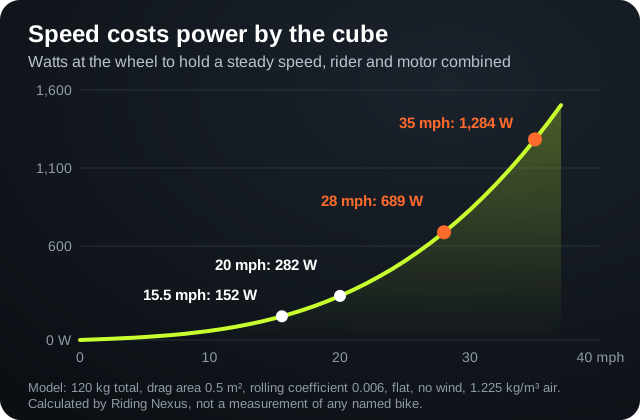
| Steady speed | Power needed | Energy per mile (km) |
|---|---|---|
| 15.5 mph (25 km/h) | 152 W | 9.8 Wh (6.1 Wh) |
| 20 mph (32 km/h) | 282 W | 14.1 Wh (8.8 Wh) |
| 28 mph (45 km/h) | 689 W | 24.6 Wh (15.3 Wh) |
| 35 mph (56 km/h) | 1,284 W | 36.7 Wh (22.8 Wh) |
At 28 mph, air drag is about 87% of the total in this model. That’s why a crouch, a smaller jacket or a calm day changes fast riding so much more than slow riding.
How far does a battery go at different speeds?
A 450 Wh battery goes about 46 miles at 15.5 mph, 32 miles at 20 mph and 18 miles at 28 mph in our model, before motor losses and with no pedaling.
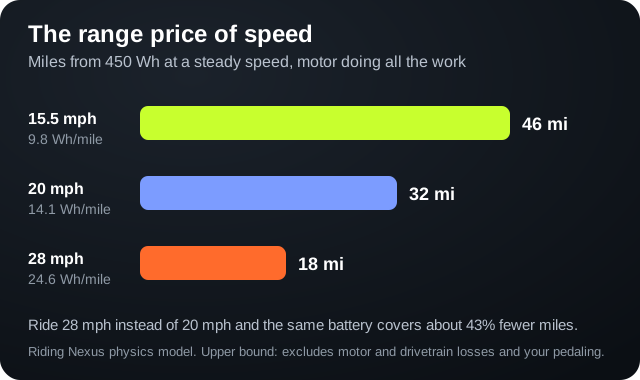
We used 450 Wh because our e-bike range calculator assumes about 90% of a battery’s rated watt-hours are usable, and 90% of 500 Wh is 450. The miles above are energy at the wheel. A real motor and drivetrain lose some energy as heat, so the battery’s share is higher than the wheel’s. Your legs help in the other direction: every watt you pedal is a watt the battery doesn’t supply.
The ratio matters more than the exact miles. Going from 20 to 28 mph cuts the distance per charge by about 43% whatever your battery size, if everything else stays the same.
How should you plan range on a fast e-bike?
Plan range on a fast e-bike from the speed you’ll actually hold, then add a buffer for wind, hills and cold.
- Pick your realistic cruising speed, not the cut-off.
- Take the energy per mile for that speed from the table, or run your own numbers in the range calculator.
- Multiply by your round trip, then add 25% as a buffer, the same margin our range calculator uses.
- If the result is more than your battery’s usable watt-hours, ride slower, charge at work or buy the bigger battery.
If your round trip at 28 mph needs more than 80% of your usable battery, drop to 20 mph on the way home. The 43% energy saving per mile is worth more than the 8.6 minutes it costs over 10 miles.
Our general e-bike range guide covers cold weather, tire choice and assist modes. For the legal side of fast riding, see our guide to high-speed electric bikes.
Mistakes to avoid when riding fast on a battery
- Trusting a range claim made at a lower speed. Ask what speed and assist level a range figure assumes.
- Riding into a headwind at full speed. A headwind adds to your air speed, and drag power grows with the cube of air speed.
- Running soft tires to “save the battery” on a smooth road. Lower pressure raises rolling resistance; check the tire pressure guide.
Where these numbers come from
The formula and the rolling resistance range come from Wikipedia’s bicycle performance page; air density from the Engineering ToolBox; both checked November 3, 2026. The drag area of 0.5 m² and the 120 kg mass are our assumptions for an upright rider and a typical e-bike, not measurements. We haven’t tested a bike for this page. Change the inputs and the miles move, but the ratio between speeds stays close.
Frequently asked questions
Does riding an e-bike faster drain the battery quicker?
Riding an e-bike faster drains more battery for every mile you cover. Air drag grows with the square of speed, so each mile at 28 mph takes about 75% more energy than a mile at 20 mph in our model. The battery empties sooner and covers fewer miles before it does.
What is the most efficient speed for an e-bike?
The most efficient e-bike speed is the slowest speed you're comfortable riding, because energy per mile keeps falling as you slow down. In our model, 15.5 mph uses about 9.8 Wh per mile against 14.1 Wh at 20 mph. Stop-start riding wastes energy too, so a steady pace helps.
How many watt-hours per mile does an e-bike use?
An e-bike uses roughly 10 to 25 Wh per mile at the wheel on the flat in our physics model, from 15.5 mph to 28 mph, before motor and drivetrain losses and without pedaling. Your pedaling lowers the battery's share. Hills, wind, cold and heavy loads raise it.
Does a lower assist level save battery?
A lower assist level saves battery mainly because you ride slower and the motor supplies a smaller share of the power. If you hold the same speed in a lower mode by pedaling harder, the bike still needs the same total power; your legs simply supply more of it.
Sources & references
We cite primary sources wherever possible: standards bodies, regulators, manufacturers and peer-reviewed research. See our editorial policy.