How to make an e-bike faster without breaking the law
Most slow e-bikes lose speed to drag you can remove for free. Past the legal cut-off, the only clean upgrade is a different bike.
The short answer
To make an e-bike faster legally, remove drag first: set tire pressure, stop brake rub, clean and lube the chain, choose a higher assist mode and ride in a lower position. Past the legal cut-off (15.5 mph in the UK and EU, 20 or 28 mph in the US) the motor can't help, so the only legal upgrade is a higher-class bike.
Key takeaways
- Free speed comes from drag: tire pressure, brake rub, chain condition, riding position and load.
- Air drag is about 78% of the power needed at 20 mph in our model, so riding position matters most at speed.
- Above the cut-off the motor stops by law: 15.5 mph (25 km/h) UK and EU, 20 mph Class 1 and 2, 28 mph Class 3.
- GOV.UK classes an e-bike that assists above 15.5 mph as a motorcycle or moped, with licence, registration and insurance.
- If you need more motor speed, buy a US Class 3 bike or an EU speed pedelec with its paperwork.
Quick steps
-
Check the bike reaches its cut-off
On a flat road in still air, ride in the highest assist mode and note the top assisted speed. If it reaches the legal cut-off, the motor is working.
-
Set tire pressure
Pump the tires to a pressure inside the range printed on the sidewall, using the tire pressure guide as a starting point for your weight and tire width.
-
Stop brake rub
Lift each wheel and spin it. If it slows quickly or you hear rubbing, have the brake aligned or adjusted before riding.
-
Clean and lube the chain
Wipe the chain, apply lube to each roller, then wipe off the excess.
-
Use the right assist mode and position
Choose a higher assist mode for speed and ride with elbows bent and torso lower to cut air drag.
-
Change the bike, not the limiter
If you still want more motor speed, buy a bike approved for a higher class instead of fitting a tuning kit.
Your e-bike feels slower than it did, or slower than your friend’s, and you want more speed. There are two very different problems hiding in that wish. This guide fixes the first one, drag you can remove for free in half an hour, and explains the legal limit on the second.
How can you make an e-bike faster?
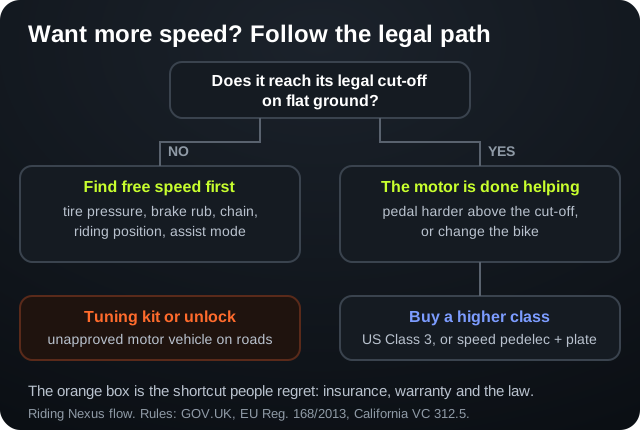
You can make an e-bike faster by removing drag from the bike and rider; once the bike reaches its legal cut-off, more motor speed means a different class of bike.
-
Check the bike reaches its cut-off
On a flat road in still air, use the highest assist mode and note the top assisted speed. If it reaches the legal cut-off, the motor is working.
-
Set tire pressure
Pump the tires to a pressure inside the range on the sidewall. Our tire pressure guide gives a starting point for your weight and tire width.
-
Stop brake rub
Lift each wheel and spin it. If it slows quickly or rubs, have the brake aligned before riding.
-
Clean and lube the chain
Wipe the chain, apply lube to each roller, then wipe off the excess.
-
Use the right assist mode and position
Pick a higher assist mode for speed and ride with elbows bent and torso lower to cut air drag.
-
Change the bike, not the limiter
If you still want more motor speed, buy a bike approved for a higher class.
The whole check takes about 30 minutes with a floor pump, a rag and chain lube. If a brake keeps rubbing after alignment, or the bike can’t reach its cut-off on the flat in its top mode, take it to a shop. That can be a sensor or motor fault.
Why does riding position make such a difference?
Riding position makes a big difference because air drag is most of the work at e-bike speeds, and your body is most of the drag.
In our physics model for an upright 120 kg rider and bike, air drag is about 78% of the power needed at 20 mph and about 87% at 28 mph. Drag power rises with the cube of speed, as Wikipedia’s bicycle performance page explains. Bending your elbows and lowering your chest shrinks the area pushing through the air. A flapping jacket or a big backpack adds to it.
This matters most above the cut-off, where your legs do all the work. It’s also why a headwind feels like a hill: drag depends on your speed through the air, not over the ground. Our speed versus range guide puts numbers on each mile per hour.
What else slows an e-bike down?
Load, low tire pressure and a low assist mode slow an e-bike down the most after air drag.
Extra weight costs most on climbs, where gravity and rolling resistance dominate. Wikipedia’s worked example on a 7% grade has air drag at only 2.1% to 6.1% of the effort. So on a hilly commute, emptying a heavy pannier helps more than tucking. Tire pressure inside the sidewall range keeps rolling resistance down; Wikipedia gives rolling coefficients of 0.003 to 0.006 for tires at their maximum recommended pressure.
Why are e-bike tuning kits a bad idea?
E-bike tuning kits are a bad idea because they raise the assist limit that makes the bike legally a bicycle, and the paperwork, insurance and warranty that came with it don’t follow.
In Great Britain the line is 15.5 mph and 250 W continuous, set by the GOV.UK EAPC rules. In the EU, Regulation 168/2013 exempts pedelecs only when assistance is “finally cut off before the vehicle speed reaches 25 km/h”. In California, Vehicle Code 312.5 defines each class by the speed where assistance ceases. A kit that moves that speed moves the bike out of the class.
Kits also put loads on brakes, tires and the frame that the maker didn’t design for at that speed. If a modified bike is in a crash, you’re the one who changed it.
Many systems now look for tuning. Bosch eBike Systems says its software can detect tuning with a sensor while you ride and then switches to an emergency mode, with an error code on the display and reduced support. Riding for about 90 minutes restores normal mode, but the check repeats; after the third detection, only a dealer with the Bosch DiagnosticTool can clear limp-home mode. Bosch also warns that tuning risks your guarantee and warranty claims, and notes that the EN 15194 e-bike standard calls for measures against manipulation.
Which bike should you buy if you need more speed?
Buy a bike approved for the higher class: a US Class 3 e-bike for 28 mph, or an EU speed pedelec with its type approval, AM licence and moped paperwork.
Our high-speed e-bike guide compares the two, and the fastest e-bikes guide lists the models we could verify at each step. In the UK, any bike assisting above 15.5 mph is a moped or motorcycle, so most riders get more speed from fitness and drag, not a new bike.
Mistakes to avoid
- Fitting a bigger or higher-voltage battery to go faster. A bigger pack adds range, not legal speed, and a pack the system wasn’t designed for can damage the controller.
- Changing the wheel size setting in the display to fool the speed sensor. The bike then reads the wrong speed and assists above its legal limit.
- Skipping the shop when the bike can’t reach its cut-off. Weak assist on flat ground in top mode can be a sensor, motor or battery problem.
Where this advice comes from
Legal limits come from GOV.UK, EU Regulation 168/2013 and California Vehicle Code 312.5, and tuning detection from Bosch eBike Systems, all checked November 3, 2026. The drag shares come from our physics model with the assumptions in the speed versus range guide, and from Wikipedia’s bicycle performance page. We haven’t tested specific bikes for this guide.
Frequently asked questions
Is it illegal to derestrict an e-bike?
Derestricting an e-bike so its motor assists above the legal cut-off usually takes it out of e-bike law. In Great Britain, GOV.UK classes an e-bike assisting above 15.5 mph as a motorcycle or moped, which needs registration, insurance and a licence. In the EU, assistance beyond 25 km/h ends the pedelec exemption.
Can I make my e-bike faster with a bigger battery?
A bigger battery makes an e-bike go further, not faster. The motor's legal cut-off speed stays the same. A pack with higher voltage than the system was designed for is a different matter: it can damage the controller and create a fire risk, so use only batteries approved by the bike's maker.
Will pumping up my tires make my e-bike faster?
Pumping e-bike tires up to the right pressure lowers rolling resistance, so the bike holds speed with less effort, especially above the cut-off where your legs do all the work. Stay within the pressure range printed on the tire sidewall and the rim's limit. Overinflating rough-road tires can make the bike skittish.
How do I make my e-bike faster uphill?
To make an e-bike faster uphill, use a higher assist mode, shift to a lower gear so you pedal at a comfortable cadence, and carry less weight. On a climb, rolling and gravity matter far more than air drag. A bike with a more powerful legal motor climbs faster without raising its top speed.
Sources & references
We cite primary sources wherever possible: standards bodies, regulators, manufacturers and peer-reviewed research. See our editorial policy.