Electric bike vs regular bike: which should you buy?
The short answer
Choose an electric bike if motor assistance makes your commute or hills practical and you can charge and store it safely. Choose a regular bike for a lower purchase budget, simpler upkeep and more effort per ride. Compare bikes that fit you, then budget for service and a possible battery replacement.
Key takeaways
- A pedal-assist e-bike adds motor power as you pedal; a regular bike relies on your pedaling.
- Our illustrative three-year cash budget is $2,764 for an e-bike and $1,250 for a regular bike, before resale.
- Assisted cycling can provide moderate exercise, although effort is often lower than on a conventional bike.
- Check local rules and the bike's actual weight before buying.
Jump to a section 10
- How does an electric bike vs regular bike compare?
- Which real bikes show the tradeoffs?
- What does each bike cost over three years?
- Which is better for commuting and hills?
- Do you get exercise on an electric bike?
- How do speed and range differ?
- Which bike fits your riding?
- What maintenance and battery costs should you plan for?
- What mistakes should you avoid?
- Where does this advice come from?
An electric bike can make a difficult commute more manageable. A regular bike has no motor or battery to charge, and it may be easier to carry.
Use the comparison below to choose for your route, then replace the example budget with quotes for the bikes and service available near you.
How does an electric bike vs regular bike compare?
Pedal assist adds motor power while you pedal, reducing the effort needed for a trip. The battery adds charging and service considerations.
| Question | Electric bike | Regular bike |
|---|---|---|
| Cost | Motor and battery add to the budget | No electrical purchase or charging cost |
| Weight | Check complete weight with battery | Check complete weight and accessories |
| Hills | Assistance can reduce pedaling effort | Climbing relies on your effort and gearing |
| Exercise | Pedaling can reach moderate intensity | Often greater immediate effort on comparable rides |
| Maintenance | Bicycle parts plus electrical system | Bicycle parts without electrical system |
| Commuting | Assistance can make hills and distance manageable | Suits routes you can comfortably pedal |
| Battery | Needs compatible charging and storage | No battery to charge |
| Assist speed in California | Class 1 and 2: 20 mph; Class 3: 28 mph | No motor assistance |
| Battery range | Depends on capacity and conditions | No battery to recharge |
The assisted speeds above are 32 km/h and 45 km/h, rounded. They are motor cutoffs, not a promise of average speed. Class definitions and access differ by location; see the legal section before choosing a bike.
Which real bikes show the tradeoffs?
These US manufacturer examples show different purchase budgets, not a controlled test or a ranking. Prices and availability change, and the bikes differ in equipment. Check fit, a local shop’s service support and the exact configuration before ordering.
| Specification | Ride1Up Roadster v3 | Giant Escape 3 Disc, 2024 |
|---|---|---|
| Manufacturer price | From $1,395 before promotions | $650 recommended retail, historical |
| Drive | Motor and pedals; chain or belt options | Pedals, 2 by 7 gears |
| Motor | 500 W hub, manufacturer rating | None |
| Brakes | Hydraulic disc | Mechanical disc |
| Published weight | 40 lb (18.1 kg), listed gravel setup | No specific weight in cited sheet |
| Range | Maker estimates 20 to 40 mi (32 to 64 km) | No battery range limit |
Ride1Up’s listing does not identify a model year; the cited page lists several frame and drivetrain variants. Its 40 lb figure is for the listed gravel setup, so weigh the exact bike with its battery and accessories before planning stairs. The Giant price is a historical recommended price for the 2024 US model, not a current stock quote. These examples are not equivalent builds, and the range is a maker estimate, not a Riding Nexus measurement.
For a lower-priced motor-assisted option, Ride1Up lists the Portola 02 Lite 10 Ah from $895. Its published weights differ: the comparison page says 54 lb (24.5 kg), while the product page lists 58 lb (26.3 kg) for the 10 Ah Lite. Confirm the complete bike’s weight with Ride1Up before planning to carry it. It folds and has a manufacturer-rated 750 W hub motor; the listing does not state a model year.
Giant’s US 2025 Escape Disc 2 listing showed a $675 sale price and a $775 original price when checked November 9, 2026. Treat the sale price as a historical snapshot and check the current price with Giant or a dealer. It has a 1 by 9 drivetrain and no motor. It is a full-size hybrid, so this is a budget comparison, not a like-for-like folding-bike comparison.
What does each bike cost over three years?
Our hypothetical cash budget is $2,764 for the e-bike and $1,250 for the regular bike. These are planning inputs, not quoted prices or measured repair bills.
| Budget item | Electric bike | Regular bike |
|---|---|---|
| Purchase | $2,000 | $800 |
| Three years of maintenance | $750 | $450 |
| Electricity | $14 | $0 |
| Total cash outlay | $2,764 | $1,250 |
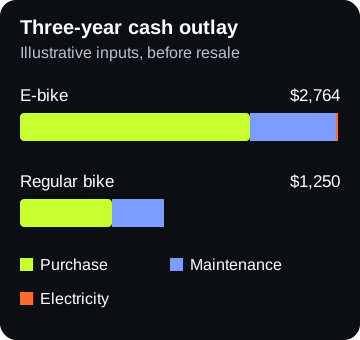
The example assumes 3,000 miles (4,828 km) over three years. The e-bike uses a hypothetical 20 watt-hours per mile at the battery, 87% charging efficiency and electricity at $0.20 per kilowatt-hour. The calculation is 3,000 × 20 ÷ 1,000 ÷ 0.87 × $0.20 = about $13.79 over three years. Use your own tariff and measured consumption where possible.
The maintenance allowances are assumptions, and no battery replacement is included. Add a model-specific replacement quote if you want to budget for one; the time at which a battery needs replacing is uncertain. This cash comparison excludes resale, financing, insurance, locks, accessories and taxes. For ownership cost after resale, subtract resale value from the purchase price to calculate depreciation, rather than counting both the full price and depreciation.
The $250 per year e-bike and $150 per year regular-bike allowances are provisional budgets for routine shop work and wear items, not published averages or a forecast. Wet roads, mileage, riding style and local labor rates can change the bill. Ask a shop for an annual service quote and prices for tires, brake pads and drivetrain parts.
For sensitivity, keep the same purchase prices and electricity inputs. If service totals $450 for either bike, the e-bike totals about $2,464 and the regular bike $1,250. If the e-bike needs an additional hypothetical $600 battery during the three years, the original e-bike scenario rises to about $3,364. These alternatives are arithmetic examples, not predictions of replacement timing or a battery quote.
Try the battery charging cost calculator with your own inputs. Its assumptions are estimates, not a measurement of your bike.
Which is better for commuting and hills?
An e-bike is useful when assistance makes a hill or longer commute manageable enough to ride regularly. A regular bike is a practical choice when the route suits your fitness and you value a simpler machine.
Imagine arriving at the foot of the last climb on your way home with a loaded bag. Test both bikes on a similar hill, and check that the e-bike’s battery and motor support the load and distance you expect. Our range guide explains why terrain, assist and weather change the result.
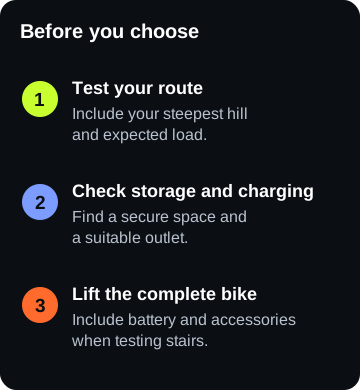
Check where you must lift or store the bike. Compare actual weights in the frame sizes you need, including any removable battery and accessories. A lighter regular bike may be easier to carry upstairs, but individual models vary.
Do you get exercise on an electric bike?
Yes. Pedaling with assistance can provide meaningful physical activity, although the effort depends on how you ride.
A systematic review found that assisted riding commonly reached at least moderate intensity, while its immediate physiological demand was generally lower than conventional cycling. The studies varied, so those findings do not predict your individual workout. Reduce assistance when you want more effort, and choose a setting that lets you ride safely.
That 2026 review included 31 studies with 11,890 participants, using different designs and outcomes. An earlier systematic review and meta-analysis also found moderate-intensity responses on average and lower physiological responses than conventional cycling. Neither finding means every assisted ride reaches moderate intensity or proves a particular individual’s long-term fitness outcome. A longer or more frequent assisted ride may change your weekly activity, but the studies do not establish that outcome for every rider.
Calories burned depend on the rider, effort, route and duration. A single universal calories-per-mile comparison would give a false sense of precision. If you have a health condition or exercise limitation, ask a clinician what intensity is appropriate.
How do speed and range differ?
An e-bike’s assist cut-off speed limits motor assistance, not necessarily the speed the bicycle can reach under pedaling or gravity. Rules and access vary by jurisdiction and bike class.
In California, the Highway Patrol’s guide describes these classes:
| Class | Motor operation | Assist cutoff |
|---|---|---|
| 1 | Pedal assistance | 20 mph (32 km/h) |
| 2 | Motor can propel without pedaling | 20 mph (32 km/h) |
| 3 | Pedal assistance | 28 mph (45 km/h) |
California’s definition limits motor-only propulsion for Classes 1 and 3, apart from the specified walk-assist exception. Other states may define throttle-equipped Class 3 bikes differently. A seller’s selectable mode does not by itself establish legal classification. Check current state and local rules, age and helmet requirements, and the land manager’s access rules. UK and European rules differ; consult our e-bike laws guide. The speed and range guide explains the energy tradeoff.
A regular bike has no battery range limit. An e-bike’s range depends on its battery, assist setting, terrain and other conditions. Check the actual route with a reserve rather than treating an advertised range as a promise.
Which bike fits your riding?
Choose for the hardest recurring part of the trip, then check fit and cost.
| Your priority | Start with | Check before buying |
|---|---|---|
| Commuting | E-bike if assistance changes which trips you can ride | Secure parking and charging |
| Fitness rides | Regular bike if you want unassisted effort | Fit, gearing and route |
| Steep hills | E-bike if assistance makes the climb manageable | Test the hill with your expected load |
| Longer journeys | Either, depending on effort and charging | Route, weather and battery reserve |
| Stairs | The bike you can safely lift | Complete weight and lift points |
What maintenance and battery costs should you plan for?
Both bikes need tires, brakes and drivetrain maintenance. An e-bike also needs compatible electrical parts and a service provider able to diagnose its system.
Before buying, ask a local shop for a service estimate and the availability and price of the exact replacement battery. Battery life varies with use, age and storage. Do not open or repair a battery pack yourself. If brakes or electrical components are damaged, stop riding and have the bike inspected.
What mistakes should you avoid?
Don’t compare sticker prices alone. Include the lock, accessories, service and storage you need. Avoid choosing a bike that you cannot lift where necessary or a battery you cannot charge safely. Check fit and brakes on a test ride, and confirm access rules for your usual route.
Where does this advice come from?
This is a research-based comparison, not a hands-on test. The exercise summary comes from the linked systematic review, while the ownership budget is an illustrative calculation with explicitly stated inputs. Sources and calculations were checked on November 9, 2026.
Frequently asked questions
Can you ride an electric bike without the motor?
Many pedal-assist bikes can be pedaled with assistance switched off, but check the specific model's manual. The additional weight and drivetrain resistance can make the ride feel different from a regular bicycle. Try the bike unassisted on a hill before relying on that option for your journey.
Is an electric bike worth the extra cost?
It can be worth it if assistance lets you ride trips you would otherwise make by car or avoid altogether. Compare the actual purchase price, servicing, charging, secure storage and potential battery replacement with the cost of your alternatives. The answer changes with your route and how often you ride.
Does an e-bike count as exercise?
Pedaling an e-bike can count as physical activity. A review of studies found that assisted riding commonly reached moderate intensity, though its immediate physical demand was generally lower than conventional cycling. Your effort depends on the assist setting, terrain, speed and your own fitness.
Sources & references
We cite primary sources wherever possible: standards bodies, regulators, manufacturers and peer-reviewed research. See our editorial policy.
- Potential Benefits of E-Bikes for Physical Activity: A Systematic Review
- Active Transportation and Micromobility
- Micromobility Battery Charging Safety
- Department of the Interior E-Bike Policy FAQ
- Electric Bicycles and Other Devices
- Roadster v3
- Escape 3 Disc (2024)
- Systematic review and meta-analysis evaluating the effects electric bikes have on physiological parameters
- Straßenverkehrsgesetz § 1
- Welke regels gelden voor mijn elektrische fiets?
- Orden PJC/780/2025
- 自転車の交通安全ガイド
- 自転車を安全・安心に利用するために