E-bike battery voltage chart: 36 V, 48 V and 52 V packs
Full, nominal and floor voltages for 36, 48 and 52 V packs from a cell maker's datasheet, set against the voltages one e-bike maker's display uses for each bar, and how to test yours with a multimeter.
The short answer
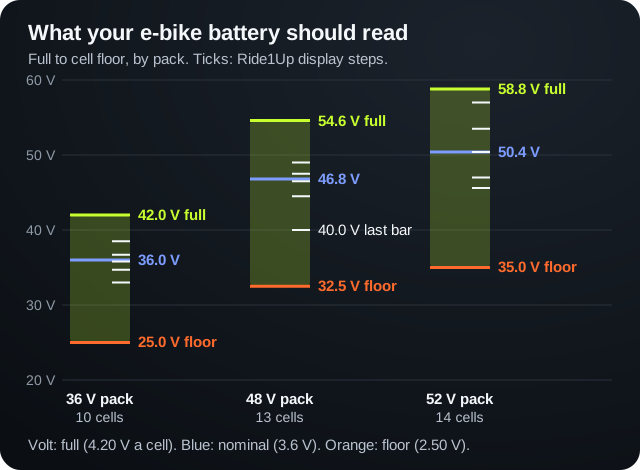
A 48 V e-bike battery has 13 cells in series and reads about 54.6 V fully charged, 46.8 V at its nominal midpoint and 32.5 V at the cells' discharge floor, from Panasonic's NCR18650B datasheet. A 36 V pack reads 42.0 V full and a 52 V pack 58.8 V. Ride1Up's 48 V display drops to its last bar at 40.0 V.
Key takeaways
- Pack voltage is cells in series times cell voltage: 36 V is 10 cells, 48 V is 13, 52 V is 14. Panasonic's NCR18650B charges to 4.20 V, is rated 3.6 V nominal and stops at 2.50 V.
- Full off the charger: 42.0 V (36 V pack), 54.6 V (48 V), 58.8 V (52 V). Cell floor: 25.0 V, 32.5 V and 35.0 V. Our calculation from the datasheet.
- Ride1Up's 48 V display steps through 49.0, 47.5, 46.5, 44.5 and 40.0 V. Its last bar sits 7.5 V above the 48 V cell floor.
- Ride1Up says its 48 V 700 Series packs peak at 52 V, below the 54.6 V a 13-cell pack reaches at 4.20 V per cell. We could not settle which figure that line of bikes really charges to.
- A 52 V charger on a 48 V pack would push each of 13 cells to about 4.52 V, past the datasheet's 4.20 V maximum. Ride1Up warns that a charger of the wrong voltage can ruin the battery.
Jump to a section 7
- Why is a 48 V e-bike battery not 48 volts?
- What is the voltage chart for a 48 V e-bike battery?
- What is the voltage chart for 36 V and 52 V e-bike batteries?
- How do you test an e-bike battery with a multimeter?
- Does battery voltage tell you the charge percentage?
- What do riders get wrong about e-bike battery voltage?
- Where these numbers come from
A 48 V e-bike battery reads about 54.6 V fully charged, 46.8 V at its nominal midpoint and 32.5 V when its cells reach their discharge floor. A 36 V pack runs from 42.0 V down to 25.0 V, and a 52 V pack from 58.8 V down to 35.0 V.
This chart is for riders who want to know what a multimeter reading means before they buy a battery, a charger or a repair. The full and floor voltages are our calculation from Panasonic’s datasheet for the NCR18650B cell, and the display voltages are Ride1Up’s own, checked November 16, 2026. We have not measured these batteries ourselves.
Why is a 48 V e-bike battery not 48 volts?
A 48 V e-bike battery is named after its nominal voltage, the average across a discharge, not the voltage you read on a meter. Its 13 cells in series read 54.6 V full and keep falling as you ride.
Every lithium-ion e-bike pack is a string of cells in series. Panasonic’s NCR18650B datasheet gives the three cell figures that set the pack’s voltages: charge to 4.20 V, rated 3.6 V nominal, discharge cut-off 2.50 V. Divide the pack’s name by 3.6 V and you get the number of cells in series: 36 V is 10 cells, 48 V is 13 and 52 V is 14. Multiply that count by each cell figure and you have the whole chart.
What is the voltage chart for a 48 V e-bike battery?
A 48 V e-bike battery runs from 54.6 V full to a 32.5 V cell floor, with its nominal 46.8 V in between. Ride1Up’s display uses five steps inside that range.
| Point on a 48 V pack (13 cells) | Pack voltage | Per cell |
|---|---|---|
| Full, off the charger (datasheet limit) | 54.6 V | 4.20 V |
| Ride1Up 48 V charger rating | 54 V | 4.15 V |
| Ride1Up display: top bar step | 49.0 V | 3.77 V |
| Ride1Up display: next steps | 47.5, 46.5, 44.5 V | 3.65, 3.58, 3.42 V |
| Nominal midpoint | 46.8 V | 3.6 V |
| Ride1Up display: last bar | 40.0 V | 3.08 V |
| Cell discharge floor (datasheet) | 32.5 V | 2.50 V |
The per-cell column is our division. It shows where the display is cautious: Ride1Up’s last bar arrives at 3.08 V per cell, 0.58 V above the cell floor, which leaves 7.5 V of the pack’s range behind the “empty” reading. That margin is deliberate. Ride1Up’s support page says that if a battery is nearly dead and the bike powers off, you should not power it up or drain it further.
Ride1Up publishes a second 48 V table for its 700 Series, Rift and LMT’D bikes: 51.0, 48.0, 46.5, 44.0 and 41.0 V, with “a peak voltage of 52v and a minimum usable voltage of around 41.5V.” That peak is a conflict with the datasheet arithmetic. Thirteen cells at 4.20 V make 54.6 V, and 52 V works out to 4.00 V per cell. Either those packs are charged to a lower voltage on purpose, which some makers do to lengthen battery life, or the 52 V figure is rounded. Ride1Up’s page doesn’t say which, so we give both numbers and act on neither.
What is the voltage chart for 36 V and 52 V e-bike batteries?
A 36 V e-bike battery runs from 42.0 V full to a 25.0 V floor, and a 52 V battery from 58.8 V to 35.0 V. Ride1Up publishes display steps for both.
| Point on a 36 V pack (10 cells) | Pack voltage | Per cell |
|---|---|---|
| Full, off the charger (datasheet limit) | 42.0 V | 4.20 V |
| Ride1Up 36 V charger rating | 42 V | 4.20 V |
| Ride1Up display steps (Prodigy, Roadster V2) | 38.5, 36.7, 35.8, 34.7, 33.0 V | 3.85 to 3.30 V |
| Nominal midpoint | 36.0 V | 3.6 V |
| Cell discharge floor (datasheet) | 25.0 V | 2.50 V |
| Point on a 52 V pack (14 cells) | Pack voltage | Per cell |
|---|---|---|
| Full, off the charger (datasheet limit) | 58.8 V | 4.20 V |
| Ride1Up display steps (Revv 1) | 57.0, 53.5, 50.4, 47.0, 45.6 V | 4.07 to 3.26 V |
| Nominal midpoint | 50.4 V | 3.6 V |
| Cell discharge floor (datasheet) | 35.0 V | 2.50 V |
The 52 V pack is not a 48 V pack with a bigger label. It has one more cell in series, so it needs its own charger. A 52 V charger stopping at 58.8 V would push a 13-cell pack to about 4.52 V per cell, our calculation, which is past the 4.20 V maximum in Panasonic’s datasheet. Ride1Up’s warning is short: “Chargers that are not the correct voltage can ruin the battery.”
How do you test an e-bike battery with a multimeter?
You test an e-bike battery with a digital multimeter set to DC volts, probes on the battery’s two main power contacts, with the bike switched off. A plain multimeter is the battery tester for this job.
-
Let the battery rest
Switch the bike off and leave the battery for at least an hour after riding or charging, our rule of thumb, so the reading is not pulled down by load or held up by the charger. Ride1Up asks for 30 to 60 minutes after a ride before charging, for the same reason of heat.
-
Set the meter
Choose DC volts on a range above 60 V, which covers a full 52 V pack at 58.8 V. Plug the black lead into COM and the red lead into V.
-
Find the power contacts
Use the battery's positive and negative power contacts as marked on the battery or in its manual, not the small signal pins. On packs with a key or button, switch the battery on as the manual says.
-
Read and compare
Hold the red probe on positive and the black on negative, read the voltage, and compare it with the chart for your pack's cell count. A reading of 0 V on a battery the charger called full means the battery has switched its output off.
Read the result with these rules, all built from the tables above:
- If a 48 V pack reads close to 54.6 V after charging, the battery is full and a bike that won’t start has a fault outside the battery. Our guide to an e-bike battery that is fully charged but not working works through those checks.
- If it reads near 46 V right after a full charge, the charge didn’t finish. Check the charger light against the hours our charging time calculator gives for your battery.
- If it reads 0 V, the battery management system has switched the output off. Try the wake-ups in our guide to resetting an e-bike battery.
- If it reads under 32.5 V, at least one group of cells sits below the 2.50 V floor. Don’t charge it at home. Take it to the bike’s maker.
Bosch, Shimano and Panasonic publish no terminal voltage test for their batteries, and Bosch tells owners to read the battery’s LEDs instead: each of five LEDs is about 20%, and below 5% they all go out. On those systems the dealer reads the battery, not a multimeter.
Does battery voltage tell you the charge percentage?
Battery voltage gives a rough charge level, not an exact percentage. The same reading means different things at rest, under load and as the pack ages.
Ride1Up’s own display shows why. On its 48 V bikes, three of the five steps (47.5, 46.5 and 44.5 V) sit within 3 V of each other, while the last step falls 4.5 V to 40.0 V. The discharge curves in Panasonic’s datasheet show the same shape: cell voltage falls slowly through the middle of the discharge and quickly near the end, so a straight line between 54.6 V and 32.5 V would overstate the charge left at mid-range. Use the display’s bars or the battery’s own LEDs for the percentage and the multimeter for the question it answers well: is the battery delivering, switched off or under the floor.
Voltage also says nothing about capacity. An old battery reads 54.6 V full like a new one but holds fewer watt-hours, so it gets to 40.0 V sooner. If your range has shrunk, our e-bike range calculator shows what a battery of your size should cover, and our guide to how far an e-bike can go explains the rest.
What do riders get wrong about e-bike battery voltage?
The commonest mistake is reading the nominal voltage as the full voltage. A 48 V pack that reads 48 V is roughly half empty, not full, because full is 54.6 V.
Second, riders measure under load or straight off the charger. A battery read seconds after unplugging the charger, or on a hill with the motor pulling, gives a number that doesn’t match the chart, which is why the test above starts with an hour’s rest.
Third, riders swap chargers across voltages because the plug fits. A 52 V charger on a 48 V pack overcharges every cell by about 0.32 V, our calculation, and Rad Power Bikes says never to use an aftermarket charger.
Fourth, riders charge a pack that reads under its floor. A 48 V battery under 32.5 V has cells below the datasheet’s 2.50 V minimum, and that is a job for the maker, not a home charger.
Where these numbers come from
The full, nominal and floor voltages come from Panasonic’s NCR18650B datasheet (4.20 V charge, 3.6 V nominal, 2.50 V cut-off), multiplied by the cells in series, our calculation. Other cells, and other chemistries such as lithium iron phosphate, use different figures, so check your pack’s label. The display steps and charger ratings come from Ride1Up’s two support pages, the charger warnings from Ride1Up and the 2019 Rad Power Bikes RadWagon manual, and the Bosch LED figures from Bosch’s classic Performance Line instructions, all read November 16, 2026. More battery explainers are in the batteries and motors hub.
Brands in this guide
Frequently asked questions
What voltage is a fully charged 48V e-bike battery?
A fully charged 48 V e-bike battery reads about 54.6 V, which is 13 cells in series at the 4.20 V charge limit in Panasonic's NCR18650B datasheet. Ride1Up says its 48 V bikes use a 54 V charger. A reading a little under 54.6 V straight after charging is normal; a reading near 46 V means the charge did not finish.
What voltage is too low for a 48V e-bike battery?
A 48 V e-bike battery is too low below about 32.5 V, the point where each of its 13 cells reaches the 2.50 V discharge floor in Panasonic's datasheet. In practice the bike stops well before that: Ride1Up's 48 V display shows its last bar at 40.0 V, and it calls about 41.5 V the minimum usable voltage on its 700 Series.
Is a 52V e-bike battery the same as a 48V one?
A 52 V e-bike battery is not the same as a 48 V one. It has 14 cells in series instead of 13, so it charges to about 58.8 V against 54.6 V, and it needs its own charger. Ride1Up's 52 V Revv 1 display runs from 45.6 V to 57.0 V across its bars.
Can I charge a 48V e-bike battery with a 52V charger?
You should not charge a 48 V e-bike battery with a 52 V charger. A 52 V charger stops at about 58.8 V, which across 13 cells is about 4.52 V per cell, above the 4.20 V maximum in Panasonic's datasheet. Ride1Up says chargers that are not the correct voltage can ruin the battery, and Rad Power Bikes says to use only its own charger.
Sources & references
We cite primary sources wherever possible: standards bodies, regulators, manufacturers and peer-reviewed research. See our editorial policy.
- NCR18650B lithium-ion cell datasheet
- Battery display: voltage and percentage readouts
- All about batteries
- Aventure owner's manual (English)
- 2019 RadWagon owner's manual (USA)
- Bosch eBike Systems original operating instructions, Performance Line drive and battery packs (0 276 001 SPI)
- Battery safety information