How to store an e-bike battery in winter
The right charge level, whether a cold garage is OK, and how to charge safely in spring. Every number comes from the battery makers and public fire-safety agencies.
The short answer
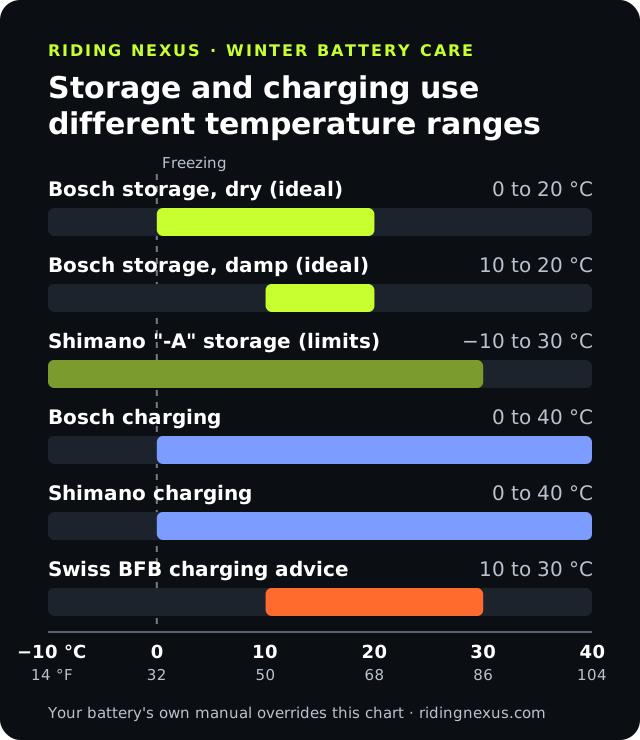
To store an e-bike battery in winter, set it to the charge level in its manual (Bosch says 30 to 60%, Shimano about 70%), unplug it and keep it somewhere dry. Bosch's ideal storage range is 0 to 20 °C (32 to 68 °F). Check the charge every few weeks, and let the battery reach room temperature before you charge it.
Key takeaways
- Bosch recommends storing at 30 to 60% charge. Shimano says about 70%, with a recharge every 6 months. 50% is not a universal rule.
- Bosch's ideal storage range is 0 to 20 °C (32 to 68 °F) when dry. A garage that drops below freezing is outside it.
- Storage and charging limits are different. Bosch and Shimano both list 0 to 40 °C (32 to 104 °F) for charging, and room temperature is best.
- Swiss fire-prevention body BFB says the first charge after months of storage carries extra fire risk. Stay home and awake for it.
Jump to a section 7
- What charge should an e-bike battery be at for winter storage?
- Can I leave an e-bike battery in a cold garage?
- How to store an e-bike battery for winter, step by step
- Is it safe to charge the battery after winter storage?
- Riding in winter instead of storing the bike
- Mistakes that shorten battery life over winter
- Where this advice comes from
It’s November, the evenings are dark and the bike is going in the garage until March. What you do with the battery in the next 15 minutes decides how it starts in spring. This guide covers the charge level, where to keep the battery, and how to charge it safely when you bring it back out.
What charge should an e-bike battery be at for winter storage?
Store an e-bike battery at the charge level its maker gives: 30 to 60% for Bosch, about 70% for Shimano STEPS. Both keep the battery away from full and empty, which Bosch says shortens battery life when a pack sits for a long time.
| Bosch | Shimano STEPS | |
|---|---|---|
| Storage charge | 30 to 60% | About 70% |
| Storage temperature | Ideal: 0 to 20 °C (32 to 68 °F) when dry. 10 to 20 °C (50 to 68 °F) if it’s damp | Allowed: −20 to 60 °C (−4 to 140 °F). Models ending in “-A”: −10 °C to under 30 °C (14 °F to under 86 °F) |
| Charging temperature | 0 to 40 °C (32 to 104 °F), ideally room temperature | 0 to 40 °C (32 to 104 °F) |
| Top-ups during storage | Check regularly and recharge to 30 to 60% if it drops | Recharge every 6 months so it never runs flat |
| Where it says so | Bosch eBike Systems, sections 6 to 8 | Shimano manual UM-7GP0B-005 |
Bosch and Shimano describe temperature differently. Bosch gives an ideal range. Shimano gives the limits the battery is rated for, and the “-A” models (the versions built to the European battery standard EN 50604-1, such as the BT-E8036-A) have a much narrower range than the rest. So check the full model code on your label, letters included.
So “store it at 50%” is right for a Bosch pack and a little low for a Shimano one. For any other brand (Yamaha, Brose, Bafang, Specialized and so on), use the number in your own manual. If the manual doesn’t give one, email the bike maker. Don’t average two brands’ advice.
Most displays show bars, not percentages. On a Bosch battery, 30 to 60% is 2 to 3 lit bars on the charge indicator, according to Tern’s Bosch battery guide. You don’t need an exact number. Anywhere inside the range is fine. That reading is the battery’s state of charge, an estimate of how full it is right now. It tells you nothing about its state of health, which is how much capacity the pack has kept since it was new.
If the battery is too full, ride it down on your last few trips of the season. If it’s too low, charge it with the original charger until it reaches the range, then unplug it. Never leave the battery on the charger for the winter. Tern says so directly for Bosch packs, and every safety agency cited here tells you to unplug once charging is done.
Can I leave an e-bike battery in a cold garage?
You can leave an e-bike battery in a garage only if the garage stays dry and inside the battery’s storage range. For Bosch that’s 0 to 20 °C (32 to 68 °F). A garage that freezes on January nights is outside it, so bring the battery indoors. Shimano STEPS batteries are rated for colder storage, down to −20 °C (−4 °F), or −10 °C (14 °F) for “-A” models. But they still need 0 to 40 °C (32 to 104 °F) to charge.
Two kinds of advice pull in different directions here. Battery makers want the pack cool but not freezing. Fire-safety agencies want it away from where people sleep. The UK Department for Transport suggests a shed or garage separate from your home where possible, but also says to avoid very hot, cold or damp places. Your garage passes both tests only if it stays dry and above freezing.
Not sure how cold your garage gets? Put a min/max thermometer where the battery would sit and leave it for a week. The overnight low is the number that matters, not the reading on a mild afternoon. Then use this table:
| If your garage | Do this |
|---|---|
| Stays dry and between 0 and 20 °C (32 and 68 °F) | Store the battery there, off the floor and away from anything that burns |
| Drops below 0 °C (32 °F), or you don’t know | Bring the battery indoors |
| Is damp, or the battery or contacts get wet | Bring the battery indoors. Let the contacts dry fully before you fit or charge it |
| Stays mild but holds fuel, paint or solvents | Store the battery somewhere else |
Indoors, pick a room with a working smoke alarm, away from heaters and radiators. Keep the battery out of hallways and off the stairs you’d use to get out in a fire, and out of shared corridors in a block of flats or apartments. That’s the UK government’s advice, and Bosch says the same: a well-ventilated room with a smoke detector, away from heat sources and flammable materials.
In Switzerland, the Swiss Fire Prevention Advisory Service (BFB) gives the same direction: keep batteries away from heat and direct sun, and disconnect them from the device during long breaks. Elsewhere in Europe, from Germany and Austria to the Netherlands, the rule is the same as in the US and UK: follow the manual for your exact battery.
How to store an e-bike battery for winter, step by step
Storing the battery takes about 15 minutes if it’s already near the right charge, plus charging time if it isn’t. You need the battery’s manual and its original charger. No tools, and you never open the battery case.
-
Find the exact model
Read the model code on the battery label (a Bosch PowerTube 625 or a Shimano BT-E8036, for example) and download its manual from the maker's website. The storage charge and temperature in that manual are the ones that count.
-
Check it for damage
Look over the case, the contacts and the charger. Swelling, cracks, leaks or burn marks mean stop: don't store it or charge it, and take it to your dealer. Clean it with a damp cloth. Never use a hose or pressure washer, which Bosch warns against.
-
Set the storage charge
Ride it down or charge it up into the range in your manual (Bosch 30 to 60%, Shimano about 70%). Unplug the charger as soon as it gets there.
-
Remove it and store it
If your battery is designed to come off, remove it, as Bosch advises for long breaks. Keep it dry, inside its storage range and away from keys, coins and screws, which can bridge the contacts and cause a short circuit. Store the bike somewhere dry too.
-
Set two reminders
One for a quick charge check every 4 to 6 weeks, and one for any recharge date in your manual (Shimano says every 6 months). If the level has dropped below the storage range, top it up while you're home and awake.
The 4 to 6 week check is our suggestion, not a manufacturer rule. Every lithium-ion battery loses a little charge on the shelf through self-discharge, and some bikes draw a small current while the battery stays fitted. The check takes a minute, and it catches a battery that’s draining faster than it should long before it gets close to empty.
Is it safe to charge the battery after winter storage?
Yes, if you let the battery warm up first and stay with it while it charges. The Swiss BFB singles out the first charge after months of storage as especially risky, because a battery that has drained very deep has a higher fire risk when it’s recharged. That’s the main reason to store the battery part-charged and check it through the winter.
Before that first charge:
- Let it warm up on its own. Bring the battery into a room at normal temperature and give it time. A battery straight from a cold garage stays colder inside than the air around it for a while. Never use a radiator, oven, hair dryer or heater to speed it up: BFB lists external heating as one of the ways lithium-ion batteries catch fire.
- Charge somewhere safe. Use a hard, non-flammable surface with nothing that burns nearby, in a room with a smoke alarm. BFB’s general advice is to charge at 10 to 30 °C (50 to 86 °F), which sits inside the Bosch and Shimano charging range.
- Stay home and awake. The UK Department for Transport, the US Consumer Product Safety Commission (CPSC) and BFB all say not to charge while you’re asleep or out. Unplug the charger when it’s done.
- Use the original charger, or a replacement the bike maker approves. The CPSC warns against “universal” e-bike chargers. A plug that fits doesn’t prove the charger is right for your battery.
If the battery won’t charge, shows an error or reads zero after the winter, stop trying and don’t look for ways around the battery management system. It may be blocking the charge on purpose. Take the battery to your dealer for a test. Bosch dealers, for example, can measure a pack’s remaining capacity with Bosch’s CapacityTester.
To plan that first charge, put your charger’s amp rating, the battery voltage and its capacity into our battery charging time calculator. If it says 4 hours, start in the morning, not at bedtime.
Riding in winter instead of storing the bike
If you keep riding through the winter, keep the battery indoors between rides and fit it just before you set off. Bosch recommends this below 0 °C (32 °F): bring the battery into a heated room and let it reach room temperature before the ride. A cold battery also gives less range until it warms up.
Our guide to how far an e-bike can go explains how much range you lose near freezing. The e-bike range calculator has a temperature setting, so you can check your usual route at winter temperatures before you rely on it.
Mistakes that shorten battery life over winter
- Storing the battery full or empty. Bosch and Shimano both set a middle level for a reason.
- Leaving it on the charger “to keep it topped up.” That’s a fire risk, and the battery’s electronics don’t turn it into a storage plan.
- Charging it straight from a freezing garage, or warming it on a radiator to save time.
- Forgetting it until April. A battery that drains to empty over 5 months is the riskiest one to recharge.
- Keeping it in the hallway because it’s warm. That’s your way out in a fire.
- Buying a cheap universal charger because the original went missing. Order the right one from the bike maker or your dealer.
Where this advice comes from
Every number on this page comes from the battery makers (Bosch and Shimano), Tern’s Bosch support guide and three public safety bodies: the UK Department for Transport, the US CPSC and Switzerland’s BFB. We checked them all on October 31, 2026. We did not test batteries for this guide. The garage table, the reminder schedule and the temperature chart are our own summary of those sources. No brand paid for this page, and it has no affiliate links. We’ll recheck the sources by January 29, 2027, or sooner if a manual changes.
Frequently asked questions
Should I store my e-bike battery at 50% or 70%?
Store your e-bike battery at the level in its own manual. Bosch recommends 30 to 60%, so 50% works for a Bosch pack. Shimano's manual for its STEPS batteries says about 70%. If your manual gives no number, ask the bike maker or dealer instead of borrowing another brand's figure.
Can I charge an e-bike battery in a cold garage?
Only if the garage is inside the charging range in your manual. Bosch and Shimano both list 0 to 40 °C (32 to 104 °F), and Bosch says room temperature is best. In winter, bring the battery indoors, let it warm up on its own and charge it while you are home and awake.
Is my battery ruined after one night in a freezing garage?
Probably not, but check it before you charge it. Bring the battery inside, let it reach room temperature and look for swelling, cracks or leaks. If the case looks fine and the display works, charge it while you are nearby. If it shows an error or won't charge, take it to your dealer.
Does an e-bike battery lose charge in storage?
Yes, slowly. Lithium-ion batteries lose a little charge through self-discharge, and some bikes draw a small current while the battery is fitted. Bosch describes its batteries as having low self-discharge. Check the level every few weeks and top it back up to the storage range if it falls.
Should I take the battery off the bike for winter?
Yes, if your battery is designed to come off. Bosch advises removing the battery when the bike won't be used for a long time. That lets you keep it indoors in the right temperature range. If only a workshop can remove your battery, store the whole bike somewhere dry and above freezing.
Sources & references
We cite primary sources wherever possible: standards bodies, regulators, manufacturers and peer-reviewed research. See our editorial policy.
- 12 questions about your eBike battery (sections 3 to 8)
- Battery and parts user's manual, UM-7GP0B-005
- Battery safety for e-cycle users
- Micromobility Information Center
- CPSC urges consumers to not buy or use universal chargers with micromobility products
- Lithium-ion battery storage and charging advice (German)
- How to care for your Bosch e-bike battery